Biorhythm Task Alignment: How Successful People Sync Task Difficulty with Brain Peak Times to Maximize Productivity
Learn the science of matching task difficulty to your brain's alertness cycles. Discover how to design your schedule based on your chronotype to maximize daily productivity.
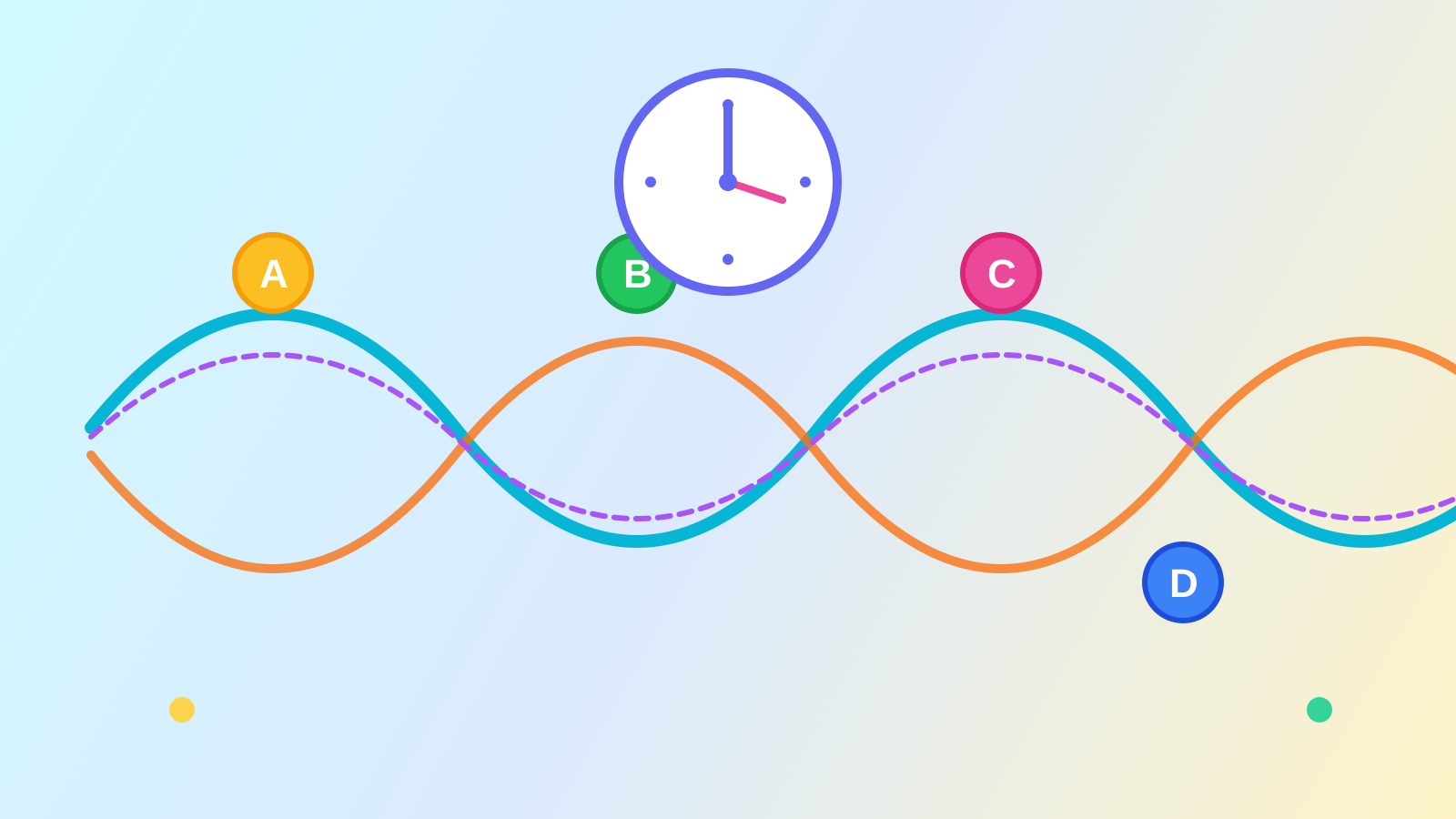
The Science Behind 40% Fluctuation in Cognitive Performance Throughout the Day
Research by Dr. Phillip Ackerman at the University of Pennsylvania shows that working memory capacity, logical reasoning ability, and creative thinking fluctuate significantly throughout the day. For most people, the period 2-4 hours after waking represents peak cognitive ability, with performance up to 40% higher than at low points. This is closely tied to the cortisol awakening response (CAR). Cortisol surges within 30 minutes of waking, creating a window when the prefrontal cortex is most active.
A study conducted by Professor Charles Czeisler at Harvard Medical School placed subjects in a time-cue-free environment and measured body temperature, hormones, and cognitive test results over 24 hours. The findings revealed that attention and logical reasoning peak in the early afternoon when body temperature is highest, and drop to their lowest between 3-5 AM when body temperature bottoms out. Interestingly, creative thinking showed the opposite pattern—unconventional ideas emerged more readily during periods of slightly reduced alertness, when mental filters were less active.
However, this golden window varies by individual chronotype. Sleep specialist Dr. Michael Breus classifies people into four animal types: morning-type 'Lions' peak from 6-10 AM, intermediate 'Bears' from 9 AM-1 PM, evening-type 'Wolves' from 4-8 PM, and irregular 'Dolphins' from 10 AM-noon. Since approximately 55% of the population are Bears, the common advice that 'mornings are most productive' applies to many people—but not everyone. Accurately identifying your chronotype is the essential first step in biorhythm alignment.
How to Accurately Identify Your Chronotype: Three Self-Diagnosis Techniques
There are three scientifically validated methods for identifying your chronotype. The first is the Munich Chronotype Questionnaire (MCTQ), developed by Professor Till Roenneberg at the University of Munich. This questionnaire calculates the 'midpoint' of your internal clock based on differences between workday and free-day sleep patterns. If you naturally wake before 7 AM on free days, you are likely a Lion; between 7-9 AM suggests Bear; and after 9 AM points toward Wolf.
The second method is the '2-Week Body Temperature Log.' Body temperature is closely linked to circadian rhythm. Measure your oral temperature five times daily—upon waking, at noon, 3 PM, 6 PM, and before bed. The time when your temperature peaks tends to coincide with your cognitive peak.
The third approach is 'Performance Tracking.' Every two hours, rate your subjective alertness on a 1-10 scale and complete a brief mental arithmetic test (such as five two-digit multiplication problems), recording both accuracy and speed. After one week, you will have an objective, data-driven performance curve unique to you. Former Google Senior Vice President of People Operations Laszlo Bock reportedly encouraged this approach within the company, noting that when employees identified their peak times and scheduled their most important projects accordingly, overall team output quality improved significantly.
Task Difficulty x Alertness Level: The 3-Zone Optimal Matching System
The core of biorhythm alignment is classifying tasks into three difficulty zones and placing them according to alertness levels. 'Zone A (High Difficulty)' includes strategic thinking, creative writing, complex problem-solving, and critical decision-making—tasks requiring deep focus and full activation of the prefrontal cortex. Place these during your cognitive peak. Specific examples include developing new business plans, designing technically complex code architectures, and creating high-stakes presentation materials.
'Zone B (Medium Difficulty)' covers proposal revisions, data analysis, important email responses, and one-on-one meetings—tasks needing steady attention. Schedule these during the stable period following your peak. While focus during this window is not as sharp as at peak, sufficient cognitive resources remain available for interpersonal communication and structured work.
'Zone C (Low Difficulty)' encompasses routine work, expense reports, simple information organizing, file management, and regular status report completion—low cognitive load tasks. Assign these to your afternoon trough. Fascinatingly, research by Professor Mareike Wieth at Michigan State University found that brainstorming during this low-alertness window can actually yield more unexpected insights, as mental inhibition weakens and unconventional connections form more easily. This means Zone C time need not be merely 'busywork time'—it can also serve as a window for free-flowing ideation.
To implement this 3-zone design, start by keeping a one-week 'alertness log,' rating your focus every two hours on a scale of 1-10 to visualize your personal alertness pattern.
Implementing a Biorhythm-Synced Schedule: A 4-Week Program
Week 1 is the 'Observation Week.' Maintain your normal schedule while recording focus and mood on a 1-10 scale every two hours. Also note wake times, meal times, caffeine intake, and whether you exercised. Do not change anything during this phase—focus purely on collecting data.
Week 2 is 'Trial Placement.' Based on the previous week's data, place just one Zone A task into your highest-focus 2-hour block. Turn off all Slack notifications, put your smartphone in a drawer, and create a completely distraction-free environment. Research by Microsoft found that it takes an average of 23 minutes to return to a task after a notification-driven interruption. This means that checking notifications just three times during a 2-hour peak session effectively cuts your real focus time by more than half.
Week 3 is 'Full Implementation.' Divide your entire daily schedule into three zones. Take concrete actions: negotiate moving morning meetings to afternoons, fix email-checking to three designated times per day, and block 'Focus Time' on your calendar during Zone A hours. Share your peak times with your manager and colleagues, and ask for their understanding regarding asynchronous communication during those windows.
Week 4 is 'Fine-Tuning.' Using three weeks of data, make micro-adjustments to optimize placement. Factor in day-of-week rhythm differences—Mondays tend to see delayed alertness onset, while Fridays often feature shorter sustained-focus durations. For post-lunch drowsiness, incorporate a 15-minute power nap or a 10-minute walk. NASA research found that a 26-minute nap improved alertness by 54%.
Five Factors That Disrupt Your Rhythm and Their Science-Backed Solutions
Understanding and addressing the factors that threaten biorhythm stability is key to long-term success. The first factor is 'Irregular Wake Times.' Harvard research demonstrates that a mere 30-minute shift in wake time can push that day's cognitive peak by up to one hour. Keeping weekend wake times within one hour of weekday times is strongly recommended.
The second factor is 'Poorly Timed Caffeine Intake.' Drinking coffee immediately after waking interferes with the natural cortisol surge. According to neuroscientist Dr. Steven Miller, the optimal window for caffeine is 90-120 minutes after waking, when cortisol begins its natural decline. Additionally, since caffeine's half-life is approximately 5-6 hours, consuming it after 2 PM degrades sleep quality and destabilizes the following day's rhythm.
The third factor is 'Blue Light Exposure.' Nighttime smartphone and computer use can delay melatonin secretion by up to three hours. Using night mode or wearing blue-light-blocking glasses starting two hours before bed is an effective countermeasure. The fourth factor is 'High-Glycemic Lunches.' A spike and subsequent crash in blood sugar worsens the afternoon alertness dip. Switching to a lunch centered on protein and fiber can reduce the afternoon performance decline by roughly 30%. The fifth factor is 'Physical Inactivity.' Regular aerobic exercise strengthens the amplitude of the circadian rhythm and further elevates peak-time performance. A 20-minute morning walk is particularly effective at stabilizing that day's alertness cycle.
Lessons from Successful Leaders and the Long-Term Impact of Biorhythm Alignment
Apple CEO Tim Cook is known for waking at 3:45 AM and concentrating strategic decision-making during his most alert morning hours. Former President Barack Obama scheduled his most critical policy decisions between 10 AM and noon during his presidency, reserving afternoons for meetings and speech preparation. To combat 'decision fatigue,' he limited his suit choices to gray or navy, conserving cognitive resources for the decisions that truly mattered.
Research cited in Daniel Pink's 'When' found that people who implemented biorhythm synchronization saw a 26% increase in productivity compared to when they arranged tasks randomly. Furthermore, a longitudinal study at Duke University confirmed that subjects who maintained this approach for six months or more experienced a 34% increase in job satisfaction and a 47% reduction in chronic fatigue.
Critically, biorhythm alignment is not a one-time design exercise—it requires continuous adjustment as seasons, age, and life circumstances change. Chronotypes tend to shift toward morning preference with age, and seasonal changes in daylight hours also affect rhythm. By conducting a one-week alertness log every three months and regularly monitoring shifts in your rhythm, you can maintain optimal performance at all times. Start today with an alertness check every two hours, and discover the golden productivity pattern that is uniquely yours.
About the Author
Success Habits Editorial TeamWe share the habits and mindsets of successful people in a way that is easy to understand and applicable to daily life.
View author profile →Related Articles
The Gratitude Meditation Habit: How Successful People Combine Thankfulness and Mindfulness to Boost Happiness and Focus
The Paraphrase Habit: How Successful People Build Deep Trust Simply by Reflecting Words Back Differently
The Facial Muscle Training Habit: How Consciously Exercising Smile Muscles Dramatically Boosts Stress Resilience and Personal Charisma
Environment-First Discipline: How Successful People Automate Habits by Designing Their Surroundings Before Relying on Willpower