The Weekly Emotional Inventory Habit: How Successful People Boost Mental Stability and Resilience Through Weekly Emotion Organization
Learn the scientific method of boosting resilience threefold with a 30-minute weekly emotional inventory, including the emotion matrix used by successful people.
The Neuroscience of How Organizing Emotions Strengthens Brain Resilience
Dr. Matthew Lieberman's research team at UCLA discovered that labeling emotions—known as "affect labeling"—suppresses amygdala activity while strengthening prefrontal cortex control functions. Using fMRI imaging, experiments demonstrated that simply verbalizing emotions reduces the brain's fear response by up to 40%. Specifically, when subjects labeled an angry face as "anger," amygdala activity decreased significantly while right ventrolateral prefrontal cortex (RVLPFC) activity increased. This neural mechanism switches the brain from "experiencing" mode to "observing" mode.
However, real-time emotion labeling has its limits. In the rush of daily life, many emotions go unnoticed and accumulate as unprocessed feelings. Dr. James Pennebaker's research at the University of Texas found that unprocessed emotions can manifest as physical symptoms, triggering elevated cortisol levels. This is where the weekly emotional inventory becomes powerful. By reviewing and systematically organizing an entire week's emotions, you can batch-process unresolved feelings. Dr. Martin Seligman's research at the University of Pennsylvania also shows that regular emotional reflection prevents learned helplessness and strengthens resilience. Successful people practice this habit on weekends to start each new week in an emotionally clear state.
Emotional Granularity: The Key Concept Behind Resilience
Dr. Lisa Feldman Barrett at Northeastern University introduced the concept of "emotional granularity"—the ability to make fine-grained distinctions between similar emotions. Research shows that someone who can differentiate between "disappointed," "contemptuous," and "jealous" rather than simply saying "I feel bad" has dramatically better stress-coping abilities.
Her team's 2001 study demonstrated that people with high emotional granularity are less likely to be overwhelmed by negative experiences and can select appropriate coping behaviors. Instead of lumping everything under "anger," being able to distinguish between "dissatisfaction," "irritation," "indignation," and "fury" allows you to choose the right response for each level. The weekly emotional inventory naturally functions as training to increase this granularity. As you reflect on the week's emotions and ask "what exactly was I feeling at that moment," your emotional vocabulary expands and self-awareness sharpens. Yale's Center for Emotional Intelligence developed a "Mood Meter" that classifies emotions into 72 types, yet most people use only about 10 emotion words in daily life. Consistent weekly inventories steadily expand this vocabulary.
How to Create and Use the Emotion Matrix
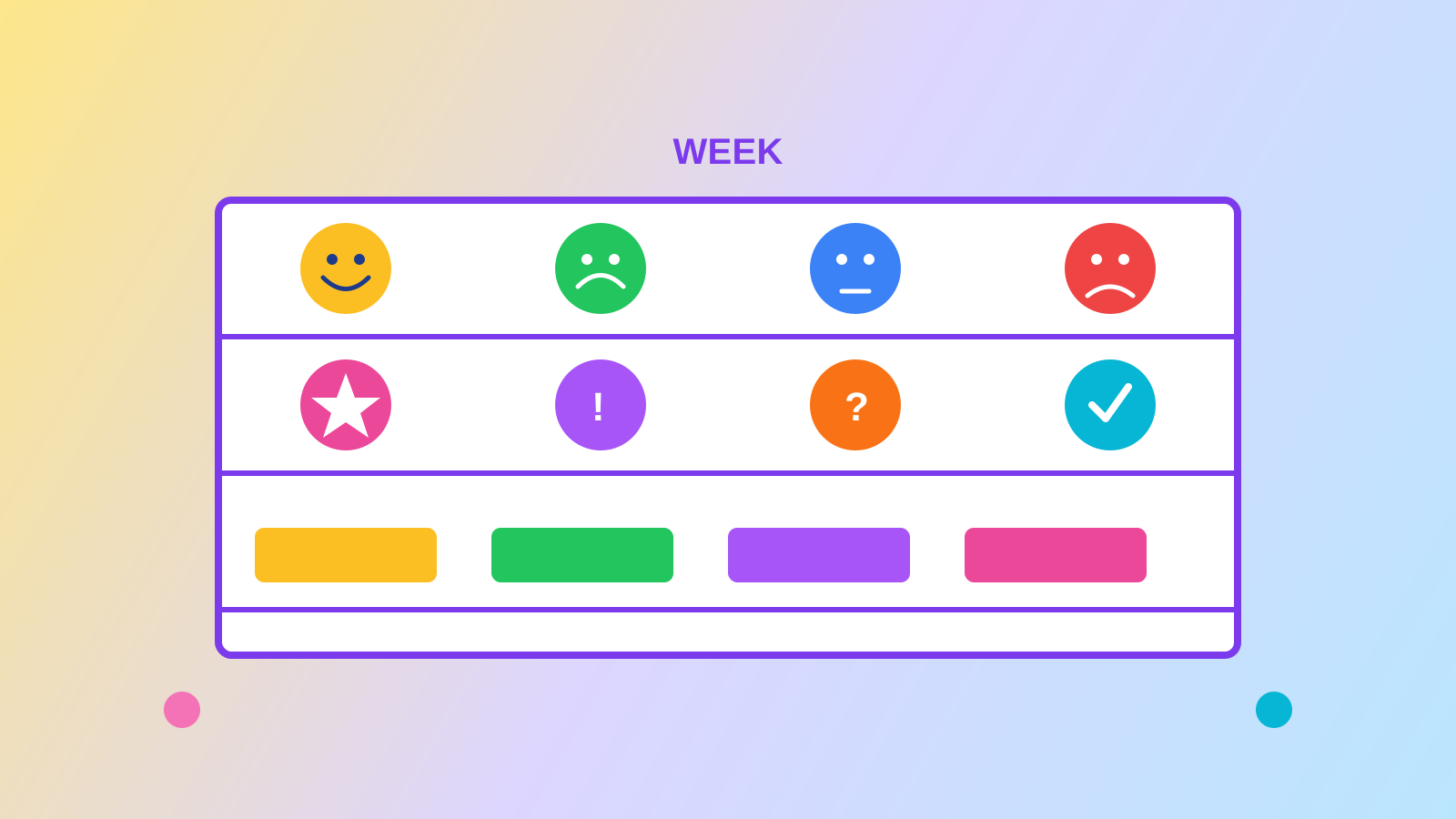
To conduct an effective emotional inventory, successful people use a framework called the "Emotion Matrix," inspired by Dr. Marc Brackett's RULER approach at Yale University. Draw a cross in the center of a page to create four quadrants, with a horizontal axis of "Positive to Negative" and a vertical axis of "High Energy to Low Energy." Upper right captures joy, excitement, achievement, and passion. Lower right holds peace, gratitude, calm, and contentment. Upper left contains anger, impatience, anxiety, and tension. Lower left houses sadness, helplessness, fatigue, and loneliness.
As you recall the week's events from Monday onward, write each emotion in the appropriate quadrant. Critically, recording the "trigger" for each emotion is essential—write entries like "Felt strong irritation when Mr. A dismissed my proposal during Monday morning's meeting," specifying when, with whom, what triggered the feeling, and what emotion arose. Additionally, rating each emotion's intensity on a scale of 1 to 10 makes patterns easier to identify later.
The particular value of the matrix is that you can visually check the balance across all four quadrants. If emotions cluster heavily in the upper left (high-energy negative), there's likely a structural problem in your work environment or relationships. Conversely, if everything falls in the lower right (low-energy positive), it may signal a lack of challenge. The ideal balance has many emotions in the right quadrants, with left-side emotions being few but "recognized." Negative emotions don't need to be zero—what matters is that they are acknowledged and converted into learning.
The 5-Step Weekend Emotional Cleansing Practice in 30 Minutes
Set aside 30 minutes on Sunday morning and follow these five steps. Morning is ideal because cortisol secretion is highest upon waking and gradually stabilizes through the morning, making it well-suited for calm self-analysis.
Step 1 (5 minutes): "Weekly Scan." Review your planner, calendar, smartphone photos, and message history, recalling each day's main events and emotions. Pay attention to physical sensations too—"My shoulders were tense on Thursday" or "I felt deeply relaxed on Friday evening." Body memories provide clues to emotions.
Step 2 (10 minutes): "Matrix Entry." Classify recalled emotions with their triggers into the four quadrants. Use specific emotion words—instead of "it was unpleasant," write "I felt looked down upon" or "I felt anxiety about being left behind." Aim for at least 10 emotion entries per week.
Step 3 (5 minutes): "Pattern Discovery." Highlight emotions and triggers that appear repeatedly. If the same negative emotion appears on the same day every week, it signals a structural problem. For example, if you feel strong impatience every Wednesday, there may be an issue with how your Wednesday regular meeting is conducted. If a specific person repeatedly triggers negative emotions, that relationship may need re-evaluation.
Step 4 (5 minutes): "Processing Unresolved Emotions." For emotions in the left quadrants, ask three questions. First: "What is this emotion teaching me?" Anger signals that an important value has been violated; anxiety is a message that you feel underprepared. Second: "How did I react to this emotion?" Recognizing reaction patterns helps you choose better responses next time. Third: "What lesson can I take from this experience?" The core of resilience is accepting negative emotions as growth hints rather than enemies.
Step 5 (5 minutes): "Setting Intentions for Next Week." Based on your matrix results, decide which quadrant's emotions you want to increase and declare one specific action. For example: "To increase 'achievement' in the upper right next week, I'll complete the project proposal I've been procrastinating on by Tuesday." This intention-setting becomes an anchor that defines the emotional direction of your coming week.
Three Strategies to Make Emotional Inventory a Lasting Habit
Many people who start emotional inventories quit within three weeks. Three evidence-based strategies help make it stick.
The first strategy is "trigger design." According to BJ Fogg's behavior design theory at Stanford, the most effective way to establish a new habit is to attach it immediately after an existing one. For example: "After I brew my Sunday morning coffee, I'll write my emotion matrix while drinking it." The existing behavior of brewing coffee becomes the trigger for the emotional inventory.
The second strategy is "starting with the minimum unit." Aiming for a perfect 30-minute inventory from the start invites failure. For the first two weeks, spend just 5 minutes writing about only the most memorable emotion of the week. Professor Fogg calls this "Tiny Habits"—the accumulation of small successes promotes habit formation. Gradually increase time and items as it becomes natural.
The third strategy is "visualizing progress." Save each week's matrix and lay out four of them at month's end. You'll instantly see emotional trends—"Compared to last month, upper-left anger has decreased and lower-right calm has increased." Seeing such changes naturally boosts motivation. This "progress visualization" aligns with Harvard professor Teresa Amabile's "Progress Principle": people are most intrinsically motivated when they can feel themselves making progress.
Practical Applications of Emotional Inventory in Business
One executive who practiced weekly emotional inventories for three months gained a crucial insight. He'd been feeling strong anxiety every Monday morning, and matrix analysis revealed the trigger was "unread emails accumulating over the weekend." By introducing a rule to empty his inbox before leaving on Fridays, his Monday anxiety dropped dramatically and his weekly starts improved significantly.
Another business professional noticed through the emotion matrix that "my energy drops every time I talk with team member B." Digging deeper, the cause turned out to be B's communication style of always starting with negation. This recognition allowed her to prepare psychologically before conversations with B, minimizing emotional drain. The key is not controlling emotions but learning to receive information from them and adjust your environment and behavior accordingly.
Emotional inventory also directly impacts leadership. As Google's "Project Aristotle" research demonstrated, the single biggest factor in team performance is "psychological safety." Leaders who accurately understand their own emotional patterns can maintain composure under high stress and provide their teams with a sense of security. The emotional inventory is a powerful tool for increasing self-awareness and, as a result, improving relationships with those around you.
Complementary Techniques to Maximize Emotional Inventory Results
Several complementary techniques can further enhance the weekly emotional inventory's effectiveness.
The first is "body mapping." Research published by Aalto University in Finland created a "body sensation map" visualizing which body parts activate with each emotion. Anger produces heat in the head and arms; sadness creates heaviness in the center of the chest. Recording "where in your body did you feel sensation" during inventory improves emotion recognition accuracy.
The second is "cognitive reappraisal." According to Dr. James Gross's research at Stanford, changing how you interpret an event can change the emotion itself. Asking "what can I learn from this?" in Step 4 is precisely this reappraisal process. For instance, reinterpreting "I was nervous before my presentation" as "my body was entering preparation mode for the performance" transforms a negative emotion into a performance ally.
The third is "gratitude recording." Dr. Seligman, founder of positive psychology, recommends a "Three Good Things" exercise of recording three positive things daily. Incorporating this into your weekly inventory by consciously recording positive emotions in the right quadrants corrects negativity bias—the human tendency to focus on negative information. Even once a week, deliberately reflecting on gratitude and joy felt during the week helps bring emotional balance into alignment.
About the Author
Success Habits Editorial TeamWe share the habits and mindsets of successful people in a way that is easy to understand and applicable to daily life.
View author profile →Related Articles
The Morning Pledge Habit: How Declaring Just One Promise to Yourself Each Morning Dramatically Transforms Your Action Power
The Curiosity Journey Habit: How Successful People Never Stop Growing by Continuously Exploring New Worlds
The 'Silent Leadership' Habit: How Successful Leaders Build Trust and Influence by Knowing When Not to Speak
The 'Ritual Gratitude' Habit: How Successful People Embed Positive Thinking at the Subconscious Level Through Gratitude Rituals