The Hope Mapping Habit: How Successful People Visualize Hope to Boost Positive Thinking and Action Power Simultaneously
Discover the science of hope mapping based on Snyder's Hope Theory and learn to visualize goals, pathways, and willpower on a single map for maximum positive impact.
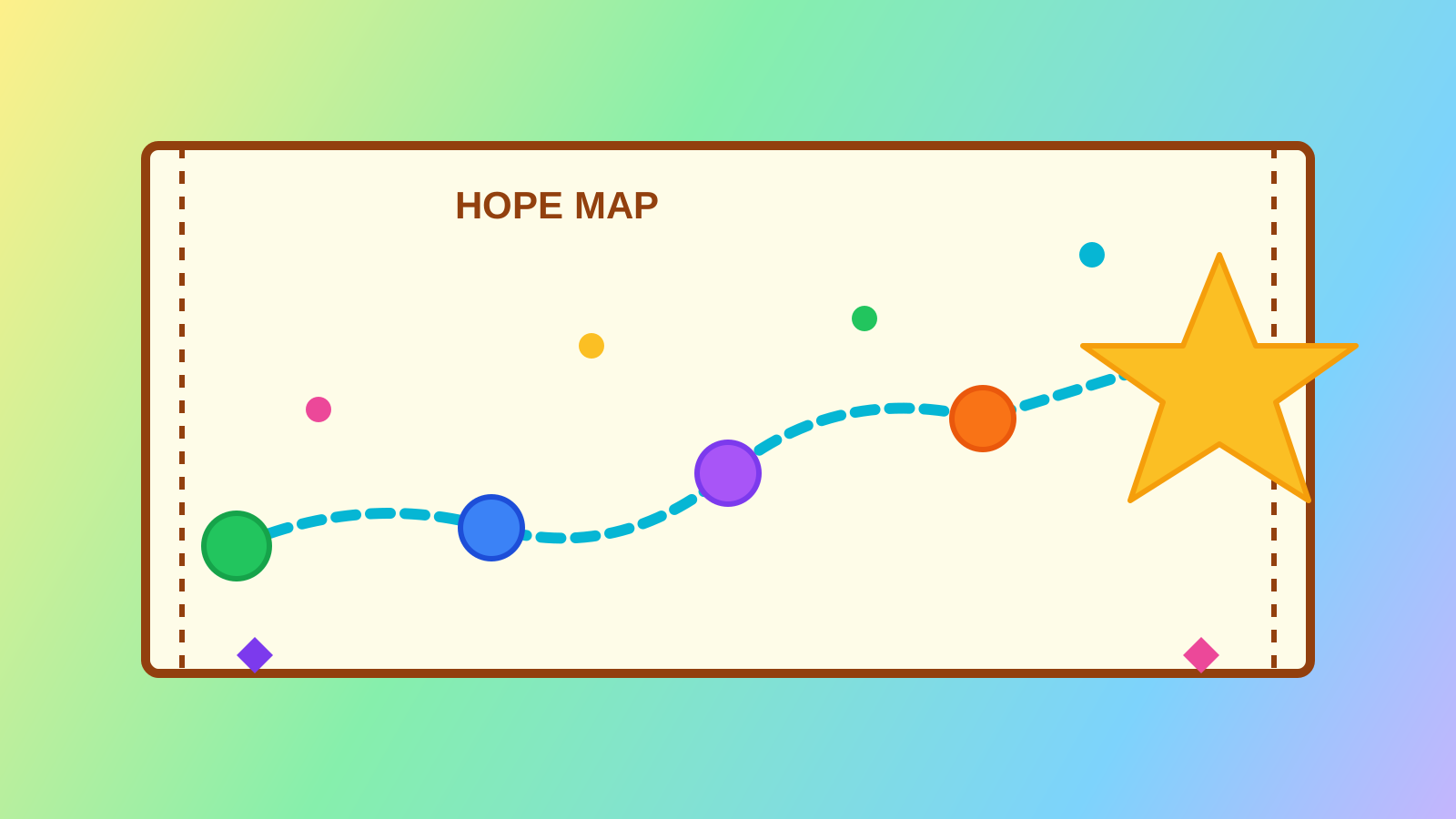
The Essence of Positive Thinking Proven by Snyder's Hope Theory
Hope Theory, proposed by Dr. C.R. Snyder at the University of Kansas, is a scientific framework backed by decades of research. According to Snyder, hope comprises three elements. First is "Goals"—having clear, meaningful objectives is the starting point of hope. Second is "Pathways Thinking"—the ability to envision multiple routes to reach your goals. People who can find alternative paths when one is blocked maintain hope. Third is "Agency Thinking"—the belief that you have the power to achieve your goals. When all three elements align, you achieve genuine positive thinking.
Research data shows that people with high hope scores perform 15% better academically, show 20% higher work performance, and recover from stress twice as fast. When Snyder's research team tracked 3,920 students at the University of Kansas, they found that hope scores at enrollment predicted six-year graduation rates more accurately than high school GPA or SAT scores. In workplace settings, the pattern holds as well. Sales professionals in the top 25% for hope scores generated approximately 26% more revenue than those in the bottom 25%.
Crucially, hope is not a fixed personality trait—it is a skill that can be strengthened through training. Snyder's own "Hope Therapy" program demonstrated that participants' hope scores increased by an average of 30% after an eight-week intervention. This means that even if you currently consider yourself a pessimist, you can cultivate hope through the right methods.
How to Draw a Hope Map: A Five-Step Process
Hope mapping is a simple visual tool you can create on a single sheet of paper or with a digital app. Follow these five steps to complete your first map.
Step 1: Write your "Goal" on the right edge of the paper. Make it specific and measurable—"Complete a marathon in six months" or "Deliver a presentation in English within three months." Avoid vague goals like "Be happier." You should be able to objectively determine whether you have achieved it.
Step 2: Write your "Current Position" honestly on the left edge. "Currently out of breath after 5km" or "Cannot speak up in English meetings." Confronting the gap between your ideal and reality is the first step toward drawing concrete pathways.
Step 3: Draw three or more "Pathways" from your current position toward the goal. "Start jogging three times a week," "Join a running club," "Adjust diet and lose 3kg"—prepare routes with different approaches. Why three or more? Snyder's research showed that people with only one pathway lose hope dramatically when they encounter an obstacle, while those with three or more pathways can flexibly switch and continue making progress.
Step 4: Along each pathway, write "Milestones" as intermediate targets. For the marathon example: "Month 1: Run 10km comfortably," "Month 2: Attempt a half marathon." Milestones keep the next step clear even on a long journey, making it easier to sustain willpower.
Step 5: Create an "Agency" section at the bottom of the map. Write down "Why I want to achieve this goal (motivation)," "Past experiences of overcoming difficulties (success stories)," and "People and resources that support me." These become the psychological fuel that sustains you through hard times.
How Successful People Apply Hope Mapping: Real-World Examples
When Elon Musk founded SpaceX with the ambitious goal of sending humans to Mars, he advanced multiple pathways simultaneously: purchasing used rockets from Russia, developing proprietary engines, and securing NASA contracts. When negotiations with Russia fell through, he had already prepared alternative pathways and could quickly pivot to in-house development. This is pathways thinking in action.
Hope mapping is also applied in the corporate world. When Microsoft CEO Satya Nadella took the helm, he set the goal of "Mobile First, Cloud First" and pursued a transformation away from the Windows-centric business model. He launched multiple pathways simultaneously—Azure (cloud), Office 365 (subscriptions), and the LinkedIn acquisition (data and networks)—creating a structure where progress continued on other pathways even if one stalled.
Individual examples abound as well. One engineer in his thirties set the goal of "Promotion to tech lead within two years" and established three pathways: "Build expertise through technical blogging," "Demonstrate leadership by organizing internal study sessions," and "Prove business understanding by proposing new projects." Even when his blog failed to gain traction, the growing recognition from his study sessions kept his motivation intact.
The Weekly Hope Practice for Integrating Hope Mapping into Your Life
To maximize hope mapping's effectiveness, schedule a 15-minute "Weekly Hope" session every Sunday. Here is the specific process.
Spend the first five minutes reviewing your existing hope map and checking which pathways you progressed along during the week. Highlight any progress with a marker and visually savor the sense of achievement. This "progress visualization" is based on Harvard professor Teresa Amabile's "Progress Principle." Amabile's team analyzed over 12,000 diary entries from 238 business professionals and found that the single strongest driver of work motivation was not rewards or recognition but "perceiving small forward movement on meaningful work."
Spend the next five minutes diagnosing and adjusting stalled pathways. If a particular pathway has been stagnant for more than two weeks, the design may need revisiting. Check whether milestones are spaced too far apart or whether you lack necessary skills or resources. Add new alternative routes if needed. Having only one path makes hope fragile. Maintaining three or more pathways at all times is the key to adversity-resistant positive thinking.
Spend the final five minutes adding one "small win of the week" to your Agency section. No matter how small—"Woke up 30 minutes earlier," "Initiated conversation with someone I find difficult," "Completed the first draft of a proposal." University of Michigan professor Karl Weick's research on "Small Wins" demonstrated that accumulating small successes builds self-efficacy and psychologically prepares you for larger challenges. Recording these small victories strengthens the belief that "I can do this" and accelerates the cycle of hope.
The Hope Reconstruction Technique for When Pathways Are Blocked
No matter how carefully you draw your hope map, unexpected obstacles will arise. What matters is knowing how to respond when they do. Snyder's research revealed that the critical difference between high-hope and low-hope individuals is not how often they encounter obstacles but their pattern of response to those obstacles.
Hope reconstruction involves three steps. First, "Objective Assessment of the Obstacle." Set aside emotional reactions and write down what happened based on facts alone. It is crucial to separate the fact—"The project was cancelled"—from the interpretation—"I am worthless." This separation, also a core principle of Cognitive Behavioral Therapy (CBT), becomes the foundation for calm re-planning.
Second, "Pathway Redesign." Generate at least two alternative routes to replace the blocked pathway. Check whether any existing milestones can be repurposed. For example, if a promotion pathway disappeared due to organizational restructuring, the expertise and network you built might be leveraged in a new pathway such as a job change or internal transfer.
Third, "Agency Recharging." Review past hope maps and recall previous experiences of overcoming blocked pathways. According to Albert Bandura's Self-Efficacy Theory, "recalling past success experiences" is the most powerful way to boost self-efficacy. The fact that you overcame difficulties before does not disappear. Consciously recalling those experiences restores the energy needed to step onto a new pathway.
The Science Behind Hope Mapping's Effects on Mind and Body
The benefits of hope mapping extend well beyond mental health. Recent research demonstrates that hope is deeply connected to physical health as well. A research team at the University of Pittsburgh tracked approximately 6,000 individuals over eight years and found that those with high hope scores had about a 13% lower risk of cardiovascular disease compared to those with low scores. The likely mechanism is that hope suppresses cortisol—the stress hormone—and improves immune function.
Hope also directly impacts performance. In sports psychology, athletes' hope scores have been confirmed as significant predictors of competitive results. A study of Olympic athletes found that medalists had significantly higher hope scores than non-medalists, with pathways thinking (having multiple tactical options) being the key differentiator. The same applies in business: sales professionals and project managers who maintain multiple approaches consistently outperform those who fixate on a single method.
Survey data from individuals who practiced hope mapping for three months or more revealed that 87% reported increased action toward their goals, 72% reported reduced stress and anxiety, and 56% reported improved relationships. The very act of drawing the map functions as a process that converts vague anxiety into concrete action plans.
Getting Started Today: Create Your First Hope Map in Ten Minutes
Once you understand the theory, the key is to move immediately into practice. You do not need to aim for perfection. Start by creating your first hope map in just ten minutes.
All you need is a sheet of paper and a pen. If you prefer digital tools, a note-taking app or mind mapping software works fine. Spend the first two minutes choosing the one goal you most want to achieve right now and writing it on the right edge of the paper. Do not forget to add a deadline. Spend the next three minutes writing your current position on the left edge and drawing three pathways toward the goal. Add at least one milestone to each pathway. Spend the remaining five minutes filling in the Agency section at the bottom with "The deepest reason I want to achieve this goal" and "Three past experiences where I overcame difficulties."
Your first hope map is now complete. Post it somewhere you will see it every day—on the refrigerator, beside your desk, or as your phone wallpaper. As Snyder's research shows, hope is strengthened through visualization. This map is not a static document but a living one that you continuously update through your Weekly Hope sessions. When a pathway is blocked, draw a new one. When a milestone is reached, color it in. Keep refueling your agency. Hope is not something you passively wait for—it is something you draw with your own hands, nurture, and transform into action.
About the Author
Success Habits Editorial TeamWe share the habits and mindsets of successful people in a way that is easy to understand and applicable to daily life.
View author profile →Related Articles
The Handwriting Goal Habit: How Writing Goals by Hand Boosts Achievement Rates by 42% — The Neuroscience and Practice Behind It
The Focus Switch Habit: 5 Trigger Techniques Successful People Use to Instantly Shift Their Brain into Focus Mode
The Weekly Emotional Inventory Habit: How Successful People Boost Mental Stability and Resilience Through Weekly Emotion Organization
The Morning Pledge Habit: How Declaring Just One Promise to Yourself Each Morning Dramatically Transforms Your Action Power