The Sunday Reset: How High Performers Use a 90-Minute Weekly Review to Double Next Week's Output
Many successful people protect a Sunday Reset — a 90-minute weekly review that reframes the past week and reshapes the next. Discover the science behind weekly reviews and a ready-to-use four-block template with concrete examples.
Why the Sunday Reset Dissolves the Monday Dread
Gallup and numerous workplace studies keep finding the same pattern: stress markers rise sharply from Sunday evening into Monday morning. The Sunday Scaries are real, and their core is not the work itself but the fog around it — during the weekend, the contours of next week blur, and the brain starts bracing against 'I don't know what is waiting for me.'
The Sunday Reset dissolves that fog by giving the week a clear shape. Neuroscientist David Rock has emphasized that uncertainty itself is a potent stressor for the brain; simply processing uncertainty into concrete information calms the prefrontal cortex. In other words, the breakthrough is not doing more or doing less but making the coming week visible before it arrives.
What unites high performers is how they frame this hour and a half: not as 'work' but as the weekly board meeting of a company of one. As the CEO of your own life, you review last week's performance honestly and decide how to allocate resources for the next seven days. The moment that reframe lands, Sunday evening stops being a block of dread and becomes the quiet place where next week is already half-won.
Three Research Findings That Validate the Weekly Review
Weekly reviews are not just a productivity fashion. Multiple streams of research support them.
First, Harvard Business School's Francesca Gino and colleagues found that workers who spent just 15 minutes at day's end reflecting on what they had learned outperformed a control group by about 23% two weeks later. If short reflections produce that kind of delta, zooming out over an entire week tends to compound the effect further.
Second, the research on 'implementation intentions' by psychologist Peter Gollwitzer and colleagues has repeatedly shown that people who pre-commit to 'when X happens, I will do Y' reach their goals two to three times more often than those who do not. A good weekly review is largely a structured way to write next week's implementation intentions in a single sitting.
Third, decision fatigue research at Cornell suggests that an average adult makes more than 20,000 micro-decisions per day, many of which silently drain willpower. Settling the top priorities in advance lets you autopilot most of the weekday's small choices and preserves your cognitive budget for the handful of decisions that actually matter.
The Four-Block Sunday Reset Template
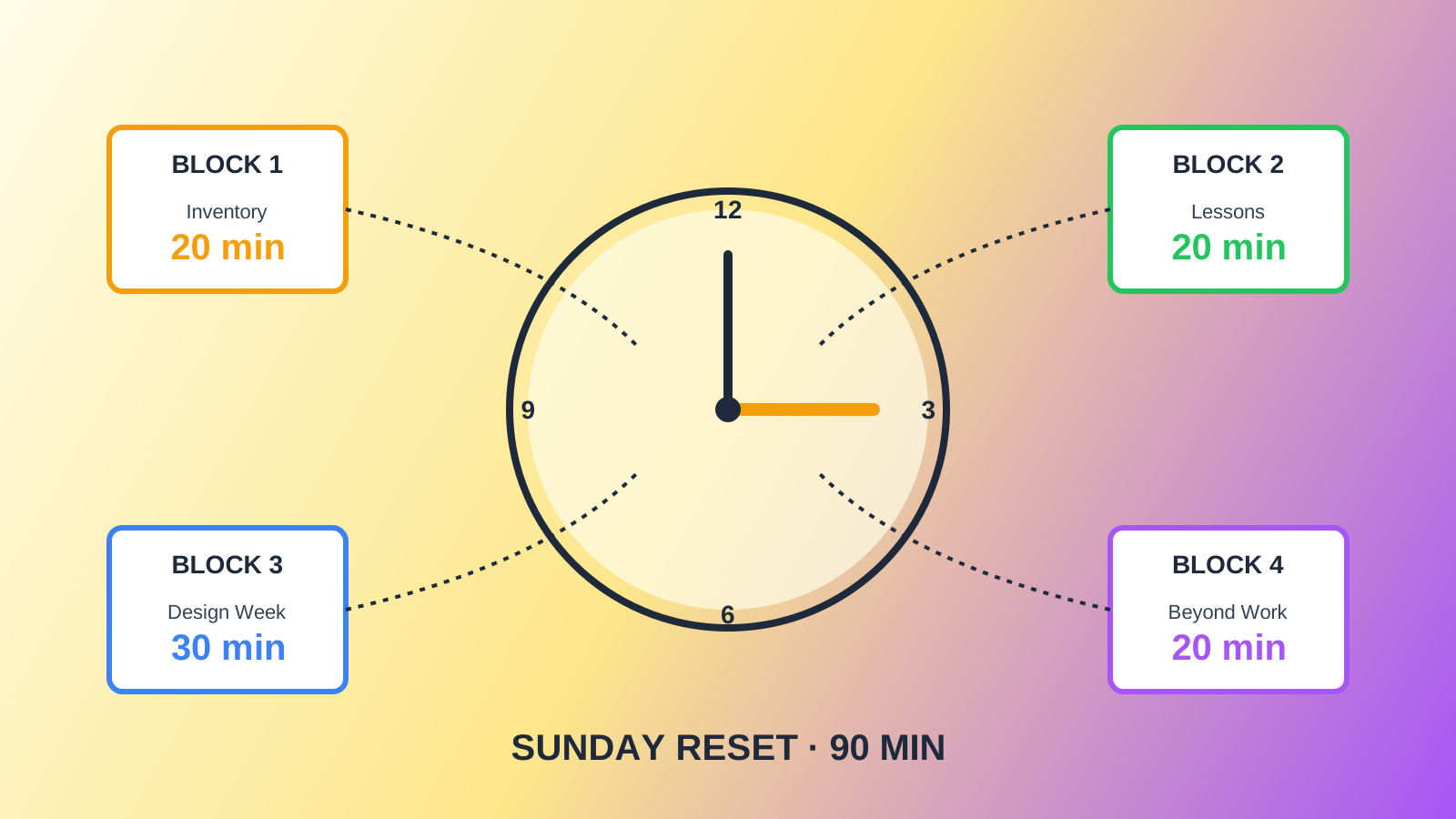
Studying weekly review rituals of high performers across fields reveals a surprisingly consistent four-block structure. Ninety minutes, split as follows.
Block 1 is 'Inventory of Last Week' (20 minutes). Open your calendar, task manager, inbox, and notes in that order and document where your time actually went. The key is starting from 'what I actually did,' not 'what I should have done.' Then list three things that went well and three that did not. Resist deep diagnosis for now — this block is strictly about surfacing facts.
Block 2 is 'Lessons and Pain' (20 minutes). From the inventory, extract two or three lessons and two or three pains you do not want to repeat. Naming the pain is what matters most: writing out 'what frustrated me' and 'which decision I regret' in specific sentences dramatically increases the odds of avoiding the same pattern next week. I remember one Sunday when I realized during this block that I had been stacking tasks right up to important meetings, which made my decisions in those meetings sloppy. From the next week on, I kept the 30 minutes before big meetings blank. That single line of insight changed months of output in ways no productivity app ever did.
Block 3 is 'Designing Next Week' (30 minutes). First, write the North Star — the three outcomes that, if achieved, would make next week a success even if everything else slipped. Then place each of those three onto specific calendar slots between Monday and Friday. Tasks without an assigned time almost never happen. Finally, write a few implementation intention lines: 'If my focus drops on Wednesday afternoon, I take a 25-minute walk,' for example.
Block 4 is 'Life Beyond Work' (20 minutes). The reason high performers sustain weekly reviews is that they do not make them only about work. In five domains — health, family, learning, money, and inner state — write one short sentence about the current situation and one small next-week action. Careers that last a long time tend to belong to people who give these areas at least a brief weekly spotlight rather than ignoring them until something breaks.
Common Failure Patterns and How to Stay With It
Most people who start weekly reviews and abandon them fall into four predictable traps.
The first is hunting endlessly for the perfect template. Tools and formats absorb far more time than the reviews themselves. There is no perfect template. A single sheet of A4 paper you can use today is enough. The second is leaving the time slot floating. Successful practitioners do it at a fixed time on Sunday evening, in the same physical spot, often with the same cup of tea or coffee. Fixing time and place drastically reduces the willpower cost.
The third trap is letting the review become purely negative. If you only write about what went wrong, the ritual starts to feel punitive and you quietly stop showing up. Always include three 'wins' from last week, however small — 'spoke up in Friday's meeting,' 'called my father.' Once your reward system starts associating this 90 minutes with positive feelings, continuity becomes dramatically easier.
The fourth trap is not translating the review into your calendar. Insights and actions that do not land on specific time blocks evaporate by Monday afternoon. Reserve the last five minutes to open your calendar and put every major decision onto real time slots.
I still remember one Monday after a weekend when I got sick and skipped the reset. The morning was unusually heavy. I reopened the same email three times in the first hour, and by afternoon I had forgotten what each meeting needed from me. Missing it once taught me, more clearly than any book, that those 90 minutes had been silently holding up my entire week.
Paper, Digital, or Both?
High performers split on the tool question. Bill Gates is famous for his physical thinking notebooks, while many digital-native founders build elaborate weekly review templates in Notion or Obsidian. There is no single right answer, but three principles consistently guide good choices.
The first principle is 'retrievability.' Can you return to this review in three or six months and actually read it again? Paper wins on writing feel and loses on searchability. Digital wins on search and loses on tactile depth. Either way, design your system so 'what was I worried about last month' is a 10-second lookup.
The second principle is a single canonical home. When insights and actions scatter across multiple apps, reviewing becomes an archaeological dig. If you use multiple tools, commit to one place where the final decisions and actions always live.
The third principle is keeping some handwritten freedom. Even teams that are otherwise fully digital often keep the emotional and intuitive sections on paper. Handwriting seems to let thoughts leave the brain before they have been cleanly structured, which is exactly what you want when you are trying to notice what is really going on.
How to Start Your Sunday Reset This Week
You do not need any special preparation. This coming Sunday, at 5 p.m. or 8 p.m., get a drink you enjoy, put your phone on Do Not Disturb, and place a sheet of A4 paper and a pen within reach. Then run the four blocks above with a 90-minute timer. The first attempt probably will not go as planned. You might spend the full hour just doing the inventory. That is fine.
What matters is not perfection but returning to the same seat next week. Three consecutive Sundays in that chair, and the Sunday Reset becomes a central pillar of your life. It is the habit most likely to be skipped when you are busy — and precisely the habit whose return on investment grows the busier you get. The real reversal high performers have made is this: instead of 'I'll skip it because I'm busy,' they think 'I'm busy, so this is the first thing I protect.' That inversion is the essence of the weekly review.
About the Author
Success Habits Editorial TeamWe share the habits and mindsets of successful people in a way that is easy to understand and applicable to daily life.
View author profile →Related Articles
Why Successful People Embrace Cold Showers: The Science of Building Mental Resilience in 30 Seconds
Biorhythm Task Alignment: How Successful People Sync Task Difficulty with Brain Peak Times to Maximize Productivity
The Gratitude Meditation Habit: How Successful People Combine Thankfulness and Mindfulness to Boost Happiness and Focus
The Paraphrase Habit: How Successful People Build Deep Trust Simply by Reflecting Words Back Differently