Trusted Network Leadership: How Successful Leaders Visualize Trust Relationships to Maximize Organizational Power
Scientifically visualize team trust relationships and strengthen weak ties to maximize organizational performance. Learn how successful leaders build trusted networks.
The Science of Trust Networks: Why Visualization Transforms Organizations
Professor Alex Pentland's research team at MIT measured organizational communication patterns using wearable devices and made a striking discovery. The greatest predictor of team success wasn't individual ability or idea quality—it was the equality of communication among members. Organizations where everyone talks equally dramatically outperform those dominated by a few voices.
Based on this research, Pentland developed the concept of 'social physics'—the idea that human behavioral patterns can be quantitatively analyzed like physical laws to predict organizational productivity. In one call center study, simply creating opportunities for all team members to interact during breaks boosted productivity by 12% and reduced turnover. This research powerfully demonstrates the importance of making trust relationships visible.
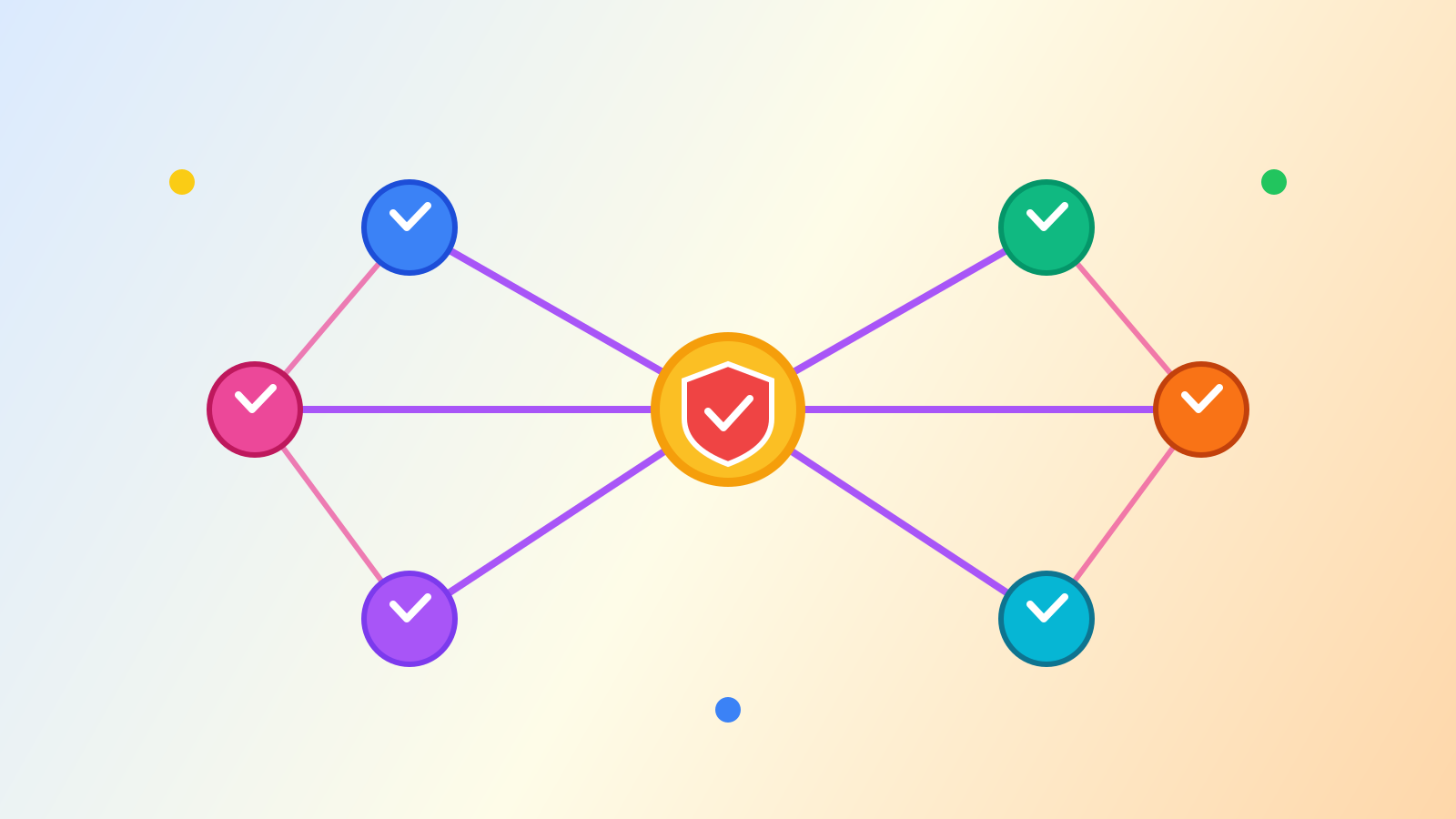
Trust network visualization maps 'who trusts whom and to what degree.' Using Organizational Network Analysis (ONA), you can clearly identify 'trust hubs' (individuals trusted by many members) and 'trust voids' (pairs or groups with thin relationships). According to Harvard Business Review, 75% of companies that implemented ONA discovered critical trust disconnections that leaders had been completely unaware of. In most cases, these invisible fractures are the root cause of project stagnation and innovation barriers.
The Mechanics of Trust: Understanding the Three-Layer Structure
Trust is not a single emotion but rather comprises three distinct layers. The first layer is 'competence trust'—the confidence that someone can reliably execute their work, built on demonstrated expertise and track record. The second layer is 'integrity trust'—the confidence that someone will keep promises and act fairly, formed through consistent behavior over time. The third layer is 'benevolence trust'—the confidence that someone considers your interests alongside their own. This layer takes the longest to build but creates the strongest bonds.
A meta-analysis by Professor Kurt Dirks at the University of Ottawa, covering 106 studies and over 27,000 participants, found that trust in leaders strongly correlates with job satisfaction (r=0.51), organizational commitment (r=0.49), and reduced turnover intention (r=-0.40). Notably, benevolence trust shows the highest correlation with performance outcomes. Successful leaders consciously invest in all three layers.
Practically speaking, competence trust is built through transparent skill-sharing. Hosting regular 'knowledge exchange sessions' where each member showcases their area of expertise makes capabilities visible across the team. Integrity trust is cultivated through the accumulation of keeping small promises—if you say 'I will reply by tomorrow,' you reply by tomorrow. This consistency ripples through the entire team. Benevolence trust grows when leaders genuinely engage with team members' career aspirations and personal interests.
Five Daily Habits of Leaders Who Build Trust Networks
The first habit is 'round-robin 1-on-1s.' Hold 15-minute monthly meetings with every team member, but the conversation topic is not work progress reports. Instead, discuss their values, current interests, and career direction. Microsoft CEO Satya Nadella transformed organizational culture through hundreds of 1-on-1 conversations with leaders after taking office. Simply opening with 'What are you passionate about outside of work lately?' can dramatically shift the quality of relationships.
The second habit is 'cross-functional introductions.' Intentionally connect members from different teams or departments, building trust bridges between groups. As sociologist Mark Granovetter's 'strength of weak ties' theory demonstrates, loose connections across departmental boundaries are the true wellspring of innovation. Making a habit of introducing one cross-domain pair per week will dramatically change information flow across the organization within six months.
The third habit is 'vulnerability-first disclosure.' Leaders share their own failures and current struggles first, raising the baseline of psychological safety across the team. As Brene Brown's research shows, vulnerability disclosure is the most powerful catalyst for trust building. Data shows that teams whose leaders openly share 'my failure this week' at the start of meetings see 2.5 times higher rates of early problem reporting. In cultures that hide failure, problems don't surface until they become catastrophic.
The fourth habit is 'gratitude visibility.' Once weekly, publicly articulate a specific team member's contribution in front of everyone. Research by Professor Adam Grant at Wharton found that employees who receive expressions of gratitude increase their helping behavior by 50% afterward. The key is specificity—not 'thanks for everything,' but 'because you stayed late to finish the data analysis for last week's client proposal, we won the contract.'
The fifth habit is 'trust gap audits.' Quarterly, visualize team relationships through anonymous questionnaires and intentionally invest in weaker connections. Questions like 'Who do you consult when facing work challenges?' and 'Who would you want to partner with on a new project?' help update the trust network map.
Practical Implementation of Organizational Network Analysis (ONA)
Here is a step-by-step guide for implementing ONA. Step 1 is 'question design.' Prepare 3-5 questions that measure trust from multiple angles. For example: 'Who do you consult for important work decisions?' (measuring competence trust), 'Who could you confide personal concerns to?' (measuring benevolence trust), and 'Whose presence on the team makes you feel secure?' (measuring general trust).
Step 2 is 'data collection.' Have each member respond to the questionnaire with guaranteed anonymity. To boost response rates, carefully explain the purpose and make clear that results will not be used for individual evaluations. Repeatedly communicate that this is a tool for enhancing team psychological safety.
Step 3 is 'visualization and analysis.' Create a network graph from the response data. Free tools like Kumu.io and Gephi, or paid solutions like Microsoft Viva Insights, can be used. In the graph, make node (person) size proportional to 'number of times trusted' and edge (line) thickness proportional to 'strength of mutual trust.' This immediately reveals 'brokers' (individuals connecting different subgroups) and 'isolates' within the team.
Step 4 is 'intervention planning.' From the analysis, identify relationships that need priority strengthening and create specific action plans. For instance, if trust is severed between two subgroups, set up joint projects or pair programming. If a member is isolated, form a task force that leverages their expertise, creating natural opportunities for interaction.
The Six-Week Trusted Network Leadership Roadmap
Weeks 1-2 are the 'observation phase.' Carefully observe who communicates frequently with whom and who is isolated. Record meeting speaking patterns, lunch groupings, and chat interaction frequency. Do not intervene at this stage—focus purely on gathering data. Simultaneously, conduct a simple ONA questionnaire across the entire team.
Weeks 3-4 are the 'intervention phase.' Execute intentional measures targeting the 'trust voids' identified through observation and ONA. Specifically, set up pair work between members with thin trust relationships, organize cross-functional lunch sessions, and host team-wide 'skill-share sessions.' For isolated members, assign roles that leverage their strengths and design opportunities for natural collaboration with hub members.
Weeks 5-6 are the 'embedding phase.' Add a 5-minute 'trust check-in' to weekly team meetings where each member shares one thing they were helped with or grateful for that week. Also establish a system for regularly monitoring 'trust indicators.' Through monthly pulse surveys, have team members rate 'trust within the team,' 'psychological safety,' and 'ease of collaboration' on a 5-point scale and track trends over time.
One IT company that implemented this six-week program reported an average 28% increase in intra-team trust scores and a 15% improvement in project deadline adherence. The critical point is not to stop after six weeks but to repeat this cycle quarterly. Trust is not something that persists once built—it is a 'living asset' that requires continuous investment.
The Long-Term Organizational Transformation Trust Networks Create
The impact of trusted network leadership extends far beyond short-term performance gains. Professor Amy Edmondson's (Harvard Business School) two decades of research has revealed three characteristics that psychologically safe teams consistently demonstrate over time. First, 'accelerated learning speed'—teams that openly share failures avoid repeating mistakes, causing their learning curves to rise steeply. Second, 'increased creative friction'—because trust exists, constructive dissent flows more freely, improving idea quality. Third, 'improved talent retention'—high-trust organizations show turnover rates over 40% lower, leading to massive reductions in recruitment and training costs.
The first step you can take as a leader starting today is to write your team members' names on paper and intuitively draw lines representing the strength of trust between each pair. That simple map becomes the starting point for organizational transformation. Trust does not emerge by accident—it is cultivated through a leader's intentional design. Build your trust network with a scientific approach and unlock your entire team's potential.
About the Author
Success Habits Editorial TeamWe share the habits and mindsets of successful people in a way that is easy to understand and applicable to daily life.
View author profile →Related Articles
The Async Deep Work Strategy: How the Courage to Disconnect Notifications Doubles Your Productivity
The Micro-Workout Habit: How Eight 1-Minute Exercise Bursts Per Day Boost Productivity by 40% According to Science
The Ownership Mentality: Why Taking Full Responsibility Triples Your Growth Rate According to Science
The Hope Mapping Habit: How Successful People Visualize Hope to Boost Positive Thinking and Action Power Simultaneously