The Five Whys Habit of High Performers: Drilling to Root Causes and Multiplying Learning
Born in Toyota's production system, the Five Whys has become a favorite thinking habit of high performers who refuse to stop at surface-level takeaways. Learn how to run the technique correctly and avoid its common misuses.
Why Surface-Level Reflection Stops Growth
'I'll be more careful next time.' 'I'll try harder.' Most of us have said sentences like these and called it reflection. The uncomfortable truth is that those sentences generate almost no new information for the brain. Neuroscience research on learning from events suggests that the depth to which a person can represent the causal hierarchy of an event largely determines how much their behavior actually shifts afterwards. Surface resolve stirs emotion but leaves the blueprint of behavior unchanged.
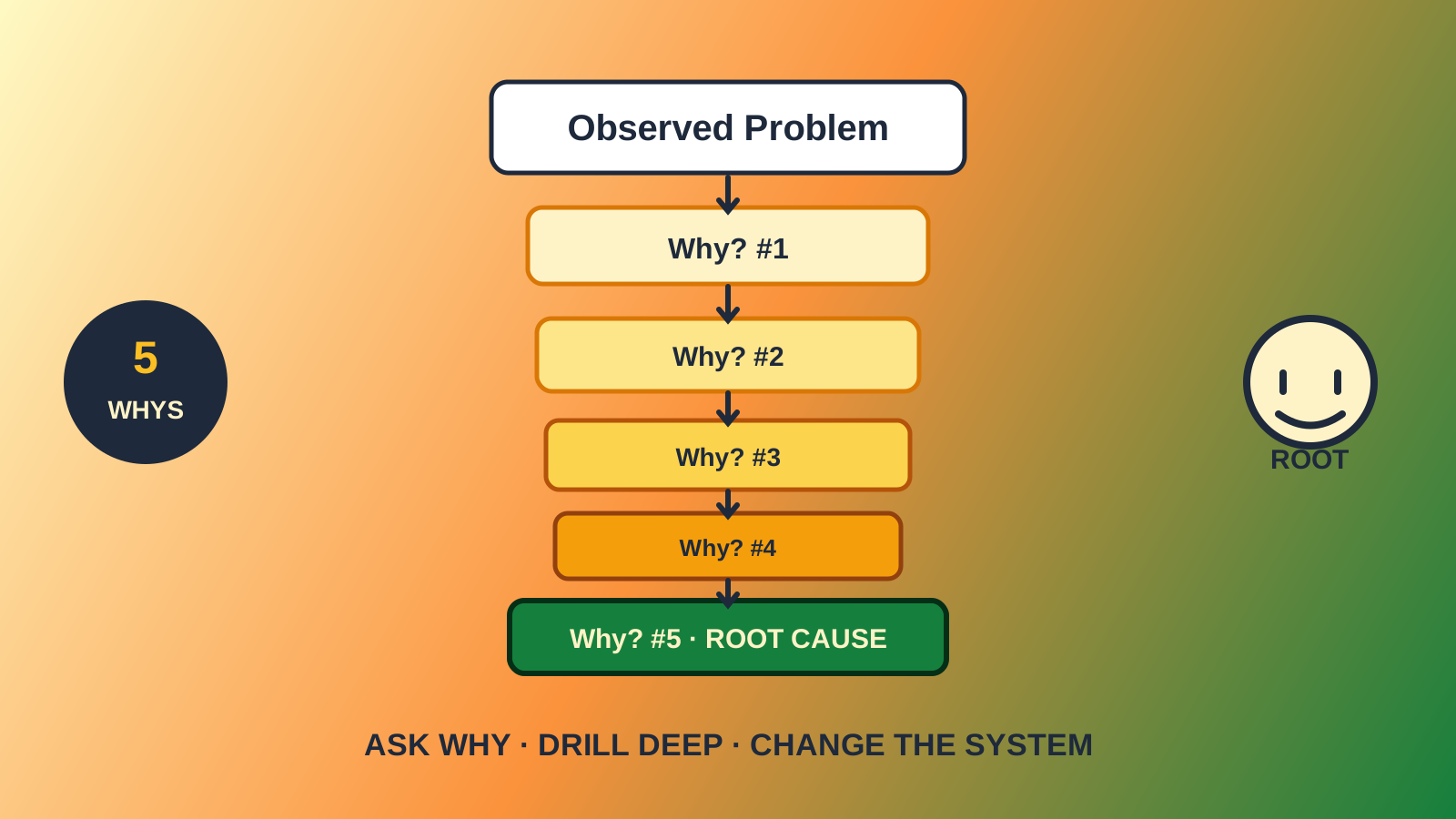
Taiichi Ohno's Five Whys, born inside Toyota's production system, is the refined answer to this problem. Starting from the observable event, you ask 'why' five times, descending at least five layers down the causal hierarchy. Only then does the system-level thing that actually needs to change come into view. Pep-talk reflection exhausts people; reaching root causes structurally eliminates entire classes of future mistakes.
Amazon still uses the Five Whys across the company because the quality of a service is determined not by surface symptoms but by structural flaws. Carol Dweck, famous for growth mindset research, argued that we should treat failures as information rather than verdicts on talent. The Five Whys is perhaps the most practical tool ever invented for doing exactly that.
The Correct Five-Step Procedure
The Five Whys looks simple, but skipping the procedure is how people get lost. Follow these five steps.
Step 1: 'State the problem as a fact.' No judgments, no labels — just when, where, and what. Replace 'the team has no motivation' with 'in this week's standup, one of five members offered an opinion.' The resolution of your first sentence governs the quality of the next five questions.
Step 2: 'First why.' The crucial habit here is aiming every 'why' at structures, not at people. Rather than 'because Alex was lazy,' write 'because the meeting was designed so that it could proceed without input.' Translate human behavior into structural language.
Step 3: 'Second through fourth whys.' Keep pushing. Do not even consider stopping until you have descended at least three layers. Most people find a satisfying-looking answer at the second why and want to stop there. Root causes almost always show up at the fourth or later. Actively resist the urge to stop early.
Step 4: 'Fifth why.' The final layer usually reveals a systemic assumption: a hidden premise in how meetings are designed, how performance is evaluated, how communication flows, or how you see yourself. Reaching one of these premises is what separates a successful Five Whys from a failed one.
Step 5: 'Aim the countermeasure at the root cause.' Never design countermeasures for intermediate layers. If you do, the same root cause simply resurfaces in a different symptom. The intervention must connect to the fifth-level cause, not to something in between.
A Worked Example: Applying Five Whys to Personal Procrastination
Abstract theory is useless without a worked example. Let's apply Five Whys to a familiar situation: 'I procrastinated on an important proposal three days in a row.'
1st why: Why did I procrastinate three days in a row? → Every time I tried to start, my focus broke and I escaped into smaller tasks. 2nd why: Why did my focus break? → The overall shape of the proposal was fuzzy in my head, so I did not know where to begin. 3rd why: Why was the shape fuzzy? → I was trying to write prose before I had any outline. 4th why: Why didn't I make an outline? → There was no time to even build an outline because my calendar was wall-to-wall meetings. 5th why: Why was my calendar wall-to-wall? → I had not pre-blocked focus time on my own calendar, so by default meetings could be slotted into every slot I did not claim.
The root cause was not laziness and not lack of ability. It was a calendar structure: no pre-blocked focus time. The countermeasure became 'every Sunday evening, block focus time for the coming week first, before anything else goes on the calendar.' I remember laughing at myself when I reached this conclusion. I had been blaming myself for weeks, and the real answer was a calendar design flaw. From the Sunday I started pre-blocking, the same class of procrastination essentially disappeared.
Three Common Misuses and How to Avoid Them
The Five Whys is powerful, but used incorrectly it becomes counterproductive. Here are the three most common misuses and how to guard against them.
The first misuse is turning it into a blame tool. 'Why did this fail?' → 'Because Alex was lazy.' → 'Why lazy?' → 'That's just his personality.' Five iterations of this simply sharpen personal attacks. The antidote is a strict rule: every 'because' must be phrased in the language of structure, assumption, or design. If a personal name appears, immediately ask, 'Why is the system producing that behavior from this person?' and keep descending.
The second misuse is drilling in a single straight line. Real problems usually have multiple intertwined causes. A pure linear descent becomes strained somewhere around the third 'why.' For serious problems, use a 'why tree' and let the first answer branch into two or three directions. The goal is a depth of five layers, not a straight line.
The third misuse is stopping at the root cause. Eighty percent of the value of Five Whys lies in the action design that follows it. Finding the root cause and stopping there means the same failure quietly remains embedded in the system. For every root cause you identify, write what you will do this week, this month, and this quarter to dismantle it — and put those actions onto a real calendar.
Three Everyday Triggers That Turn the Five Whys Into a Habit
The Five Whys is not just a conference-room tool. Many high performers run a micro version of it during ordinary moments of the day. Try using these three triggers.
The first trigger is 'a strong emotional response.' You got irritated, discouraged, or disproportionately excited. Large emotional swings are signals that one of your assumptions has been struck. Spend three minutes before bed asking 'why did that meeting irritate me so much?' and walk it down five layers. By the fifth, a quiet assumption often surfaces — something like 'I am unusually sensitive to being dismissed when I speak.' Seeing the assumption clearly is what finally allows you to choose your relationship to it.
The second trigger is 'making the same kind of mistake twice.' Once may be bad luck; twice is a system. Run the Five Whys immediately and translate the conclusion into a structural change. I once missed two important replies in the same week, ran the drill, and landed on 'notifications are shredding my work context into tiny pieces.' After adjusting the notification rules, that class of mistake essentially vanished.
The third trigger is 'things going surprisingly well.' The Five Whys is not only for failure. 'Why did my focus flow so easily today?' run five levels down produces a repeatable condition list. Most people undervalue understanding why their good days are good. The people who quietly dominate are the ones who know the exact structural conditions of their peak performance and rebuild those conditions deliberately.
Expanding the Five Whys to Teams and Families
Once you can run the Five Whys on yourself, expanding to teams and family brings its own challenges.
The largest enemy in a team setting is the absence of psychological safety. The deeper a 'why' chain goes, the closer the answers sit to uncomfortable personal or organizational truths. If defensive reflexes take over, everyone retreats to safe, shallow answers, and the exercise goes hollow. Google's Project Aristotle showed that psychological safety is the single strongest predictor of team performance. Before starting any Five Whys in a team, explicitly say: 'Every cause we surface today is material for improving systems, not material for evaluating individuals.'
In families or partnerships, negotiate who the problem belongs to before the questioning begins. If one person defines the problem alone and launches into five whys, the other experiences it as an interrogation. Start with 'we' — as in 'why were we both short on patience this week' — and the exercise becomes collaborative, and the relationship itself levels up.
A Minimum Viable Five Whys Habit for Today
Finally, here is the minimum viable Five Whys habit you can start tonight. You need a notebook and three minutes.
Before bed, pick one event from the day — either something that moved you emotionally or something that did not go well — and write five 'whys' in your notebook. You do not need to reach a perfect root cause. Three minutes is fine. What matters is holding the pen at the same time every day.
After thirty days, something visible happens. You notice that the failures you keep repeating converge onto a handful of shared root causes. You realize that most of your life problems are not 'many different issues' but 'a small number of structural patterns, repeating.' That realization reshapes the trajectory of your life far more forcefully than any tactical improvement. The Five Whys is the shortest ladder we have to that realization.
About the Author
Success Habits Editorial TeamWe share the habits and mindsets of successful people in a way that is easy to understand and applicable to daily life.
View author profile →Related Articles
The Sunday Reset: How High Performers Use a 90-Minute Weekly Review to Double Next Week's Output
Why Successful People Embrace Cold Showers: The Science of Building Mental Resilience in 30 Seconds
Biorhythm Task Alignment: How Successful People Sync Task Difficulty with Brain Peak Times to Maximize Productivity
The Gratitude Meditation Habit: How Successful People Combine Thankfulness and Mindfulness to Boost Happiness and Focus