The Failure-Insurance Mindset of High Performers: Designing Safety Nets That Free You to Take Real Risks
Hesitation is rarely a courage problem; it is usually a design problem. Discover how high performers build the failure-insurance mindset and safety nets that turn frightening risks into reasonable, repeatable bets.
Why 'I Can't Take Risks' Is Almost Always a Design Problem
Many people blame themselves as 'timid' or 'indecisive' when they hesitate to take a new challenge. Neuroscience suggests something different: the freeze response is usually the amygdala overreacting to 'losses with unknown shapes,' not a personality flaw. The brain weights losses roughly twice as heavily as equivalent gains — and ambiguity about what failure would even look like compounds that distortion until action becomes physically hard.
What separates high performers from the rest is not the volume of their courage but the fact that they design the exit before they enter. Investor Naval Ravikant has put it bluntly: 'Successful people are not reckless. They keep making bets where the downside is bounded.' Before they take a risk, they design the safety net that will catch them if it fails. This is the failure-insurance mindset.
Because the safety net exists, they can move boldly. Moving boldly without a safety net is not bravery; it is recklessness. Once you understand that the gap between courage and recklessness is design, not personality, resilience stops being a talent and becomes a learnable skill.
A Three-Layer Framework for Designing Failure Insurance
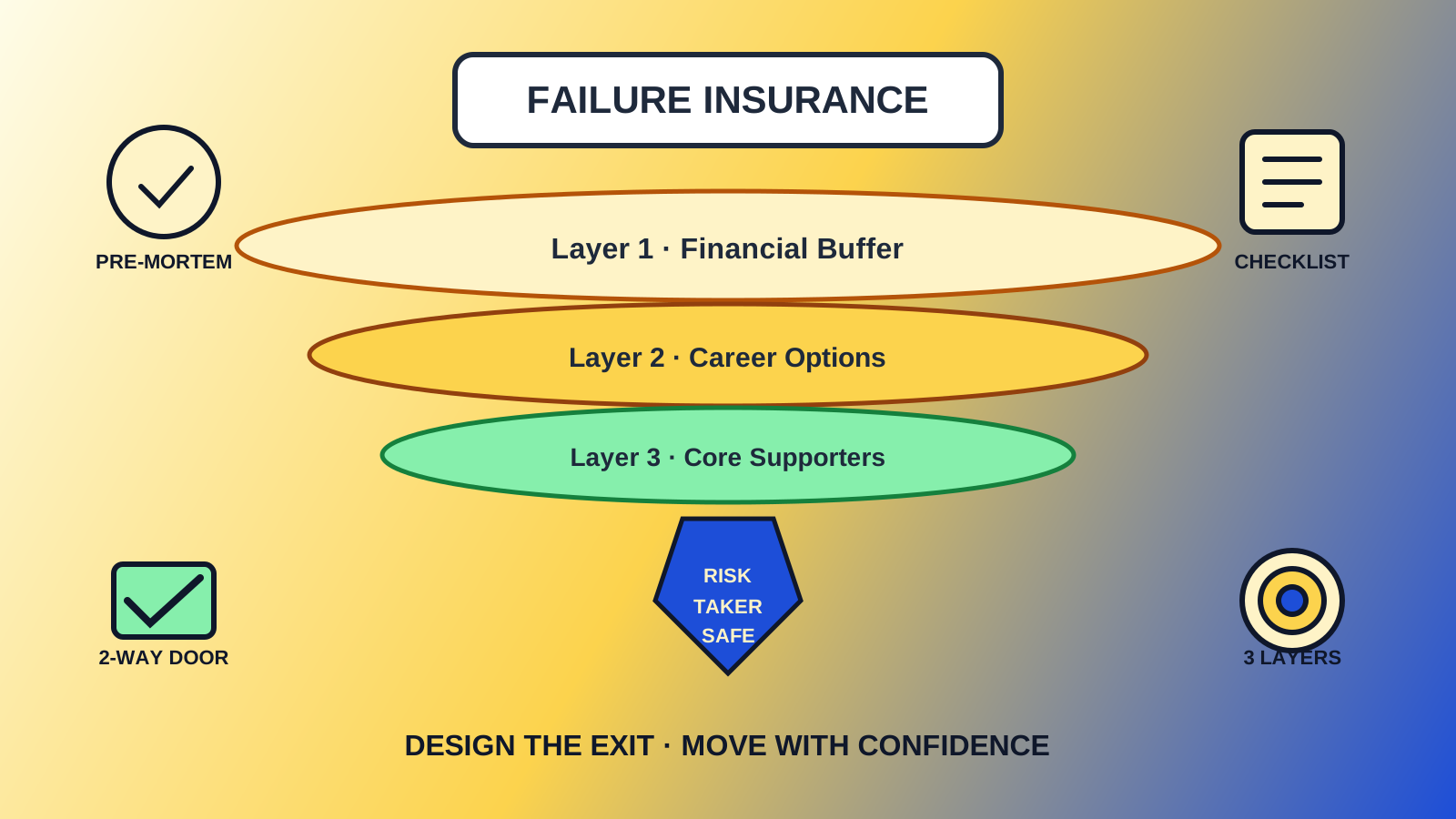
Failure insurance does not work if you assemble it on instinct. Build it in three explicit layers.
Layer one is the financial safety net. Estimate the maximum cost of the challenge in actual currency, and confirm that this amount fits inside a 'buffer that will not break your life if lost.' FIRE-community research suggests that holding six to twelve months of living expenses in a separate emergency account dramatically improves the quality of decisions made under risk. The simple fact that 'losing this much will not affect tomorrow's rent' calms the amygdala and lets the prefrontal cortex think.
Layer two is the career safety net. Write out, in advance, exactly how you would reconnect your career if the challenge fails. Once a year, take stock of your network, your skills, and your concrete results, and draw a map: 'If this challenge fails tomorrow, I have these three plausible routes back to a stable position within three months.' LinkedIn research suggests that people who can name three concrete next options at the moment of a transition recover roughly 40% faster than those who cannot.
Layer three is the mental safety net. Decide, ahead of time, who supports you and what you do when things break. Identify three core supporters who will pick up the phone in a hard moment, and maintain those relationships during peacetime, not only at the moment of crisis. Pre-decide a recovery ritual for hard nights — a walk, journaling, a long warm bath. Psychology is clear: in a crisis, your cognitive load is too high to invent new coping mechanisms, so the rituals you decided in calm times are the ones that actually run.
Premortem Analysis: Experience the Failure First
The most powerful tool for making failure insurance concrete is the premortem, championed by Nobel laureate Daniel Kahneman. The premise is a thought experiment: imagine the challenge has already failed, and write down — now — why it failed.
The technique is simple. Before launching a new challenge, write at the top of a page: 'Six months from now, this challenge has completely failed. Why?' Then list five to seven failure scenarios — lack of resources, a key person leaving, a market shift, your own health, family resistance — using past tense, not future. Past tense matters: the brain processes 'this already happened' with less defensiveness than 'this might happen.'
What almost always emerges is that three or four of those failure modes can be prevented in advance. Only the residual 'truly unhedgeable uncertainty' is the real risk. Most people freeze in a vague 'everything is scary' state, but a premortem makes them realize that 'only two of these are unhedgeable,' which collapses the perceived height of the wall.
The night I first tried this for a side project, the exercise revealed that 80% of my anxiety came from just two things — household finances breaking and the day job finding out and downgrading me. For the first I opened a separate account exclusively for side income; for the second I re-read the company's policy and decided to operate only inside the publicly disclosable range. When I put down the pen, the heaviness in my chest dissolved in a way I still remember vividly. That was the night I actually started.
Two-Way Doors vs. One-Way Doors
Jeff Bezos famously trained Amazon to classify decisions as either two-way doors or one-way doors. A two-way door is a decision you can walk back through; a one-way door is one you cannot reverse once you cross it.
Bezos's instruction was: make two-way-door decisions quickly and experimentally; spend serious time only on one-way-door decisions. The reason most people are slow to act is that they treat every decision as if it were a one-way door. In reality, eighty to ninety percent of life's challenges are two-way doors — if it fails, you can come back.
Starting a hobby, trying a side income, moving to a new neighborhood, switching jobs — almost all of these are two-way doors. You can return or pivot. Real one-way doors are rarer: marriage, having children, major surgery, taking on enormous debt. Those genuinely deserve patience.
Making this two-way / one-way distinction a habit changes the speed of your life. The simple act of asking 'is this a two-way door or a one-way door?' before acting collapses the time spent on two-way decisions by an order of magnitude. The volume of life experiments rises, and that volume is itself the deepest source of resilience: every recovery from a small failure is a deposit into your psychological insurance.
Five Daily Habits That Strengthen Your Failure Insurance
Safety nets degrade unless you maintain them. These five small habits keep yours strong.
First, automate emergency savings. Set up an automatic transfer from each paycheck into a dedicated account. Willpower will not build the layer-one buffer; the system will.
Second, run a five-minute monthly skill review. At month's end, write three lines: a new skill gained, a result you can point to, a connection added. Twelve months of those lines update your career map automatically.
Third, schedule contact with your core supporters. Put a recurring monthly meal or call with each of your three core supporters on the calendar. Relationships activated only in crisis are fragile. The small contacts during peacetime are what make the safety net real when it is needed.
Fourth, run intentional micro-failures every week. Pick one small risk: try a new restaurant alone, read in a field you find intimidating, start a conversation with someone difficult. A brain that experiences small failures regularly responds with a much milder amygdala signal when the larger challenge arrives — the same mechanism captured by stress inoculation research.
Fifth, audit your safety nets quarterly. Once every three months, spend thirty minutes reviewing all three layers. Has the emergency fund stayed intact? Are the career options still current? Are the core-supporter relationships still alive? The act of auditing alone strengthens the net.
Why Building Safety Nets Increases — Not Decreases — Risk-Taking
'Won't safety nets make me too comfortable to take risks?' The behavioral-economics evidence points the opposite direction. A Stanford study of entrepreneurs found that those with explicit safety nets launched roughly 3.2 times as many new projects as those without.
The mechanism is straightforward. The moment the brain can quantify the cost of failure, it reclassifies the risk from 'unknown threat' to 'managed expense.' Once that reclassification happens, the amygdala quiets and the prefrontal cortex regains its strategic capacity. The frequency of attempts goes up, and so does the probability of success — a virtuous loop.
Professional poker players use the same principle. They decide, before sitting down, the maximum amount they are willing to lose in a session, and then play aggressively inside that boundary. Knowing exactly how much can be lost is precisely what makes calm aggression possible. The principle generalizes to every kind of life challenge.
On one of my own difficult nights, stuck on a work problem, I opened my finance app and saw that the emergency fund equaled six months of expenses. The next morning I pitched an idea I had been holding back for weeks, and it came out steady. It is a strange feeling — the number in your bank account, not the contents of your wallet, pushing your back forward. Once you experience it, you do not give it up. Failure insurance is not a brake on action. It is the engine.
A Ten-Minute Failure-Insurance Checklist for Tonight
Finish with a ten-minute checklist you can run tonight. Five questions reveal exactly where your safety net stands.
One: How many months of expenses are in your emergency fund right now? If it is under three months, design a plan to climb to six.
Two: If you lost your current job, can you name three concrete recovery routes you could activate within three months? If not, the network and skill review become urgent.
Three: Can you instantly name three people who will absolutely listen to you on a hard day? If not, start re-investing in those relationships during ordinary weeks.
Four: What was one small risk you took intentionally this week? If nothing comes to mind, schedule a weekly micro-challenge starting tomorrow.
Five: For the big challenge currently on your mind, have you written a premortem on paper? If not, spend thirty minutes tonight listing five concrete failure scenarios.
Running this checklist once per quarter compounds your resilience reliably. The gap between people who take real risks and people who do not is not innate courage. It is whether they have engineered failure insurance. The thirty minutes you spend tonight quietly defines the size of the bets you can take a year from now.
About the Author
Success Habits Editorial TeamWe share the habits and mindsets of successful people in a way that is easy to understand and applicable to daily life.
View author profile →Related Articles
The Five Whys Habit of High Performers: Drilling to Root Causes and Multiplying Learning
The Sunday Reset: How High Performers Use a 90-Minute Weekly Review to Double Next Week's Output
Why Successful People Embrace Cold Showers: The Science of Building Mental Resilience in 30 Seconds
Biorhythm Task Alignment: How Successful People Sync Task Difficulty with Brain Peak Times to Maximize Productivity