The 15-Minute 1:1 Habit of Successful Leaders: Why Short, Regular Conversations Triple Team Performance
Great 1:1s are about cadence and quality, not length. Learn how to implement Andy Grove's 15-minute 1:1 habit, codified by Google, with concrete frameworks grounded in psychological safety and self-determination theory.
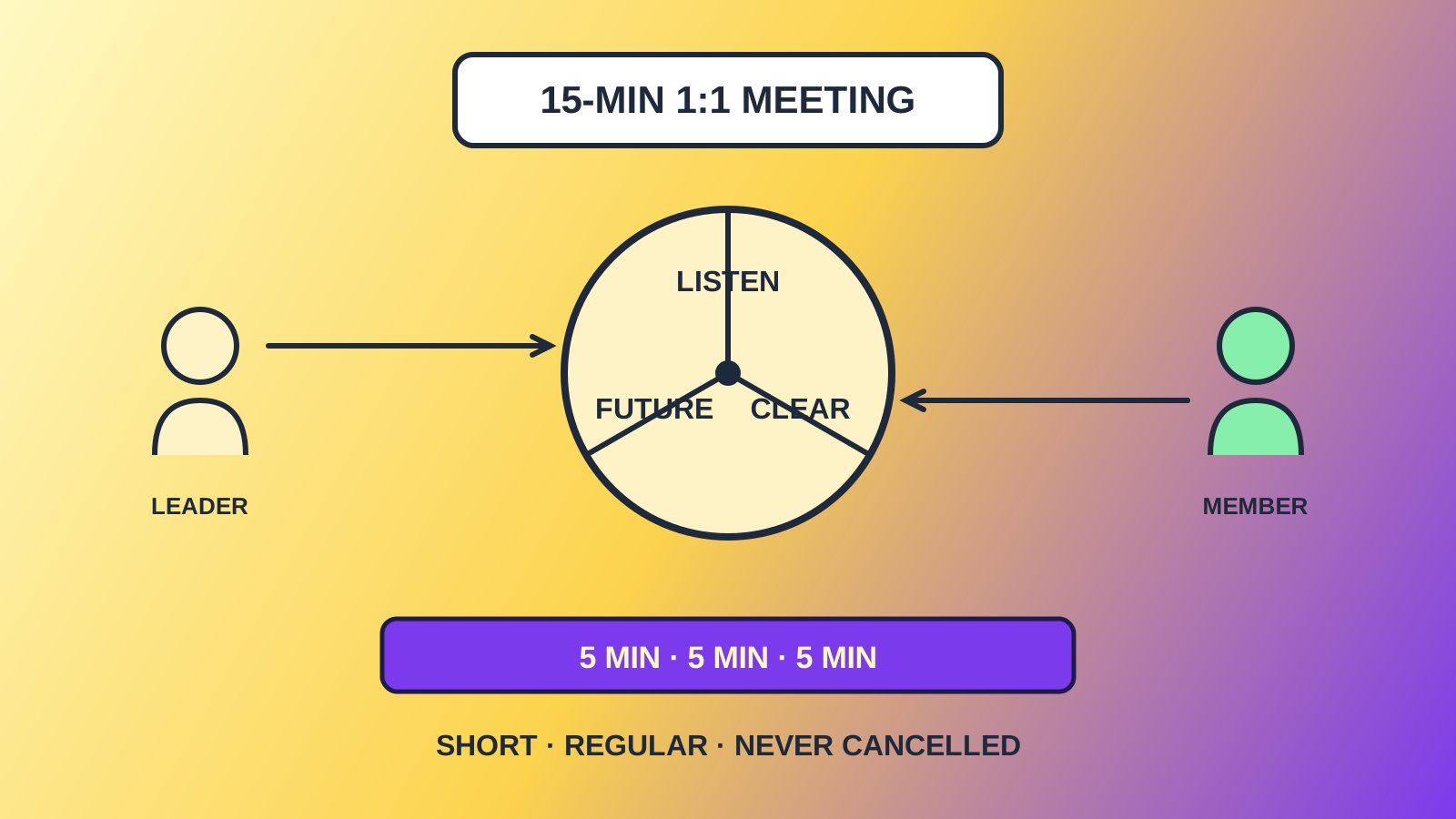
Why a 15-Minute 1:1 Triples Team Performance
Google's well-known Project Oxygen study found that one of the top three behaviors of effective managers was 'holds regular one-on-ones.' Subsequent internal analysis from the same company showed that teams whose manager held at least one fifteen-minute 1:1 per week scored 3.2 times higher on engagement and had 67% lower attrition than teams whose manager held them only sporadically.
The gap is not produced by length. It is produced by cadence and quality. Andy Grove, Intel's legendary CEO, described the 1:1 in High Output Management as 'the highest-leverage ninety minutes a manager spends.' Empirically, four fifteen-minute conversations per month outperform a single sixty-minute meeting decisively. The neuroscience is clear: trust is built by repeated short contact, not by single long sessions — the simple mere-exposure effect.
Great leaders treat the 1:1 not as a status report but as periodic maintenance for the team member's career and emotional state. That single reframing changes the quality of leadership at the root.
The Golden Format: A 5-5-5 Structure
Fifteen minutes is short. To make it deep, you need structure. The 5-5-5 format used at Google and many leading companies is reliable.
The first five minutes belong to the team member. Open with something like 'How are you?' or 'What's been taking up the most space in your head this week?' and then listen. The leader speaks no more than ten percent of the time. Most managers are tempted to chime in here; the discipline of pure listening for five minutes is what unlocks the real answers.
The next five minutes are about removing obstacles. 'What's slowing you down right now?' 'Is there anything I can take off your plate?' Help the person clarify what is actually in their way. The leader's main job is not to provide answers but to clear the path. Project Oxygen reported that effective managers spend roughly three times as much time removing obstacles as giving instructions.
The final five minutes are about the future and the career. 'Three months from now, who do you want to be?' 'If you could change one thing about your current work, what would it be?' Many 1:1s end at the immediate task list, which is a huge missed opportunity. Spending only five minutes on the future is enough to make the team member feel that the leader is genuinely thinking about their life, and engagement rises sharply.
Three Language Rules That Build Psychological Safety
To grow psychological safety inside a 1:1, the leader has to police their own language. These three rules transform the conversation.
First, eliminate evaluative language entirely. 'Try harder.' 'I expect more.' These phrases make the team member feel judged and shut down honesty. Replace them with observational, curious phrasing: 'How does that feel?' 'What are you thinking about?' Amy Edmondson's research on psychological safety found a strong negative correlation between the frequency of evaluative language and team candor.
Second, disclose your own vulnerability first. When the leader says, 'Honestly, I'm uncertain about this decision myself,' or 'I haven't been happy with how I ran last week's meeting,' the team member learns that vulnerability is allowed. Brené Brown's research has made the case that this kind of strategic vulnerability is now considered essential to modern leadership.
Third, do not fear silence. After you ask a question, allow the silence to last at least seven seconds. Within that silence, the team member begins searching for a deeper answer. FBI negotiator Chris Voss made the same point in Never Split the Difference. Most managers find the silence uncomfortable and rush to fill it; in that exact moment they cut off the deepest thinking the team member was about to surface.
Seven Golden Questions People Want to Answer
Many leaders do not know what to actually ask. These seven questions almost always work.
One: What did you spend the most time on this week? Best for situational awareness.
Two: What energized you most this week? Reveals the source of motivation.
Three: What drained you most this week? The answer here is the obstacle the leader should remove.
Four: What is currently slowing you down? Pulls out concrete blockers.
Five: What's one way I'm helping right now, and one way I'm getting in the way? A rare and valuable feedback channel for the leader.
Six: Three months from now, who do you want to be? Activates the career frame.
Seven: What is one thing you'd like me to follow up on by the next 1:1? Builds continuity.
You do not need to ask all seven in fifteen minutes. Pick two or three and go deep. The point is to ask questions that signal personal interest, not task verification.
Three Implementation Rules That Keep 1:1s Alive
The biggest enemy of the 1:1 is being the first thing cancelled when work gets busy. These three rules prevent that.
First, lock the cadence on the calendar. At the beginning of each quarter, drop three months of 1:1 slots in at once — four per month for weekly, two per month for biweekly. Once the slots exist, other meetings cannot easily push them out. Cancelled 1:1s are not a discipline problem; they are a calendar-design problem.
Second, the agenda belongs to the team member. If the leader brings the agenda, the meeting becomes a status update. Make it explicit that the team member sets the agenda; ask them to drop up to three items into a shared doc beforehand. The quality of the conversation rises immediately.
Third, only the team member is allowed to cancel. When the leader cancels for an urgent task, the team member silently learns 'I am low priority.' Never cancel from the leader's side; if it is unavoidable, reschedule inside the same week without exception. Just this discipline communicates 'this person genuinely matters to me' more loudly than any speech.
When I first became a team lead, I ran monthly 30-minute 1:1s. There was a stretch where I cancelled two months in a row citing busyness, and three months later that team member quietly handed in their resignation. In the exit conversation they said, 'I had things I wanted to talk about for a long time, but it became impossible to bring them up because it felt like you'd put me at the back of your list.' I literally could not stand up from my chair for several minutes. From that day on I switched to biweekly fifteen-minute slots and built a system where I — as the leader — never cancel. Attrition dropped visibly, and the day a team member said, 'I've been able to work with peace of mind lately,' was the day I finally understood what 1:1s are really for.
A Follow-Up Note Habit That Doubles the Effect
A simple mechanism that elevates 1:1 quality by an order of magnitude is the follow-up note. After every 1:1, the leader sends a three-line message to the team member.
The three lines are: line one, what stayed with the leader from the conversation; line two, what the leader will do before the next session; line three, the strength the leader is counting on in this person. Sending this every time signals that the conversation was not a one-off, that the team member is being thought about continuously.
MIT organizational research found that teams whose leaders send any kind of follow-up message after a 1:1 score 2.4 times higher on engagement than teams whose leaders do not. Three minutes of writing on top of fifteen minutes of conversation transforms the leadership relationship.
Reviewing these notes monthly has a side benefit: the trajectory of the team member becomes visible. A leader who can say six months later, 'Six months ago you were stuck on this exact obstacle, and look at what you've done since,' wins absolute trust.
A Minimum Viable 1:1 Practice for This Week
Finish with the smallest possible starting point. Do not try to design a perfect program; start this week.
Step one: pick the one team member you are most concerned about and put a fifteen-minute slot on the calendar this week. You do not need to roll this out to everyone at once. Start with one.
Step two: at the start of that first 1:1, say, 'This time belongs to you. You can talk about anything.' Just that single sentence shifts the air of the room.
Step three: hold to the 5-5-5 structure, and during the first five minutes commit to listening only. When you feel the urge to give an opinion, return another question instead.
Step four: send a three-line follow-up message at the end. Three minutes is enough.
Step five: two weeks later, do it again with the same person, and gradually expand to others. Adding one team member per month gets you to weekly 1:1s with the entire team in roughly six months.
Fifteen minutes can shift the trajectory of an entire organization. Excellent leadership is not built from large decisions; it is built from a long accumulation of small conversations. Put the first fifteen-minute slot on the calendar before you close this page.
About the Author
Success Habits Editorial TeamWe share the habits and mindsets of successful people in a way that is easy to understand and applicable to daily life.
View author profile →Related Articles
The Failure-Insurance Mindset of High Performers: Designing Safety Nets That Free You to Take Real Risks
The Five Whys Habit of High Performers: Drilling to Root Causes and Multiplying Learning
The Sunday Reset: How High Performers Use a 90-Minute Weekly Review to Double Next Week's Output
Why Successful People Embrace Cold Showers: The Science of Building Mental Resilience in 30 Seconds