The One-Page Summary Habit of High Performers: Turning Books Into Lifelong Wisdom Through Disciplined Compression
If you forget books soon after reading them, you are skipping the compression step. Learn the one-page summary habit used by Bill Gates and Warren Buffett, grounded in the generation effect and knowledge integration science.
Why We Forget 90% of What We Read
Reading fifty books a year, yet being able to summarize only a handful of them in three sentences six months later — this is the reality most professionals face. Ebbinghaus's forgetting curve shows that humans lose roughly 66% of newly learned information within 24 hours and about 79% within a month. Reading is no exception.
Why, then, can Bill Gates and Warren Buffett still articulate the core of books they read more than a decade ago, despite reading fifty or more per year? Both share the same habit: write a one-page summary of every book read. Gates is known for compressing each book into a single sheet of A4 after finishing it, and Buffett has spoken publicly about cementing knowledge by rewriting major ideas in his own words.
Cognitive science calls the act of reconstructing learned information in your own words the 'generation effect.' Studies show it raises retention roughly 2.5 times compared with passive reading. A University of Washington study found that participants who wrote a summary immediately after reading retained 67% more knowledge a month later than those who did not. The quality of reading is determined not by the number of books finished but by the quality of the summary written afterward.
A Five-Block Template for the One-Page Summary
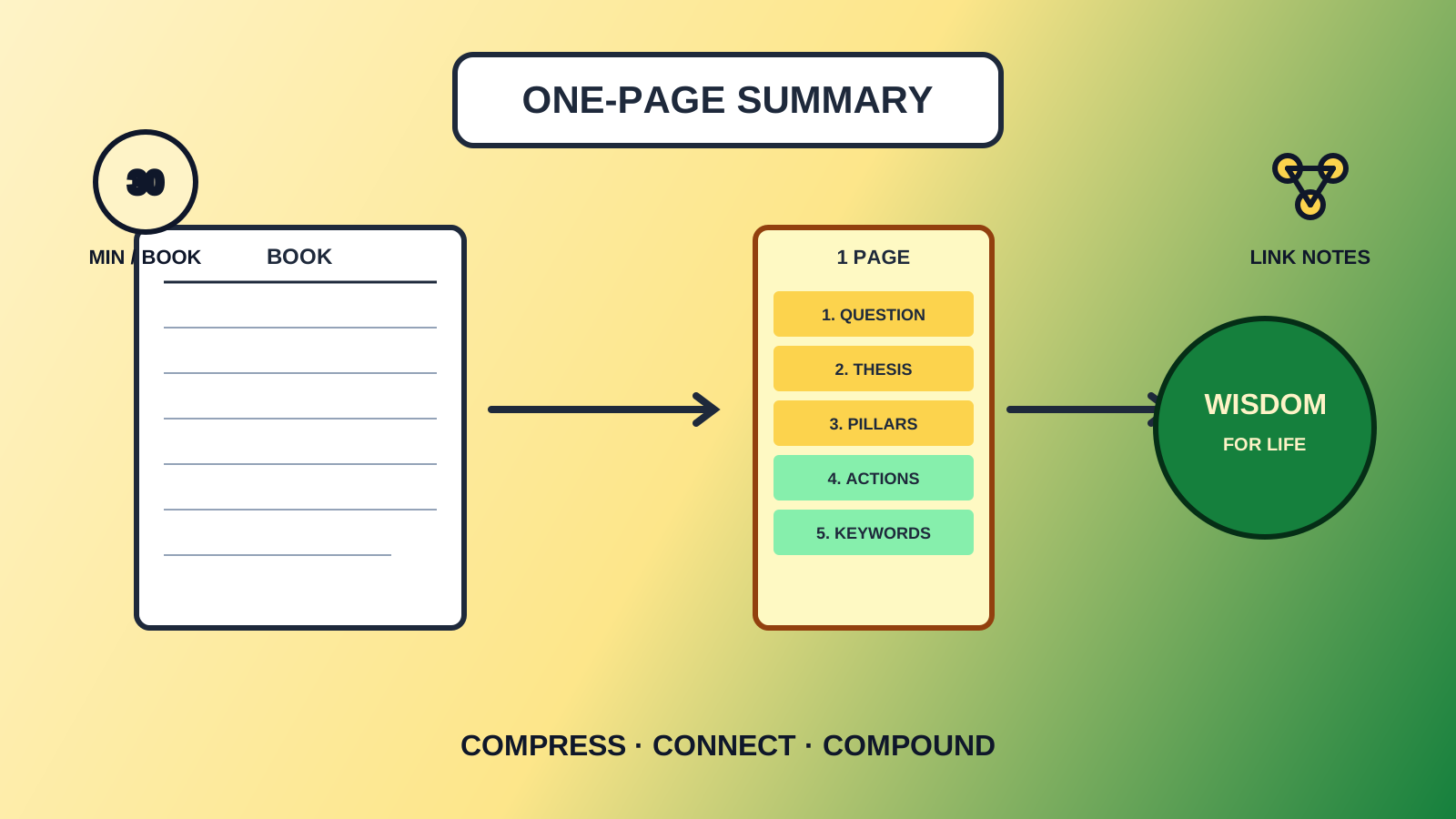
Written on instinct, summaries come out shapeless every time, take too long, and are not reusable. Use the five-block template below and almost any book can be summarized in under thirty minutes.
Block 1: the single question this book is answering. Ignore the title and table of contents and write, in one sentence, the question the entire book is actually answering. For The 7 Habits of Highly Effective People, that might be 'What do truly effective people repeat every day?' Naming the question makes the structure of the whole book snap into focus.
Block 2: the central thesis. Write the author's argument in one or two sentences — in your own words, never as a quote. If you cannot, you have not yet understood the book.
Block 3: the three pillars supporting the thesis. List the three main lines of evidence, data, or examples the author leans on. The skeleton of the entire book becomes visible.
Block 4: three concrete actions for your life. Translate the knowledge into behavior. Specify when, where, and what. 'Be more aware' or 'think about it' is not enough — write actions an outsider could observe.
Block 5: three keywords to use as re-entry triggers in 30 days. When you re-read the summary later, these keywords should pull you instantly back into the world of the book. They are the keys to long-term memory.
Fitting these five blocks onto a single page converts the book's knowledge into a form you can still use months later.
The Feynman Technique: Test Whether You Can Truly Write It in Your Own Words
The sharpest test for summary quality is the Feynman technique, named after the Nobel laureate physicist. The standard is brutal: 'If you cannot rewrite a concept in language a middle schooler would understand, you do not yet understand it.'
It has four steps. Step one: write the concept in plain language without jargon. Step two: notice exactly where you stumble — that gap is the gap in your understanding. Step three: return to the book to fill in only that gap, which makes re-reading highly efficient. Step four: rewrite, again, in plain language. Repeating this loop converts a book's content fully into your own words.
Layered onto the template, the Feynman test means writing block two — the central thesis — under the constraint of 'no jargon, explain it as if to a middle schooler.' This dramatically deepens how knowledge becomes truly your own. Many people mistake reading for the act of moving the eyes across letters; the real act is translating into your own language.
Building a Database of Summaries: The Zettelkasten Method
Writing a single-page summary per book is already powerful. Connecting them into a network multiplies the effect exponentially. The German sociologist Niklas Luhmann published more than ninety books in his lifetime largely thanks to a note-taking system he developed: the Zettelkasten, or 'card box.'
Today, Notion, Obsidian, or Roam Research make implementing a Zettelkasten trivial. Three principles matter most.
First, one note per idea. Beyond the per-book summary, extract individual ideas into separate notes. A single book typically generates five to ten idea notes.
Second, link between notes. Whenever you create a new idea note, link it to two or three existing notes. Knowledge starts forming a network instead of a stack.
Third, walk the garden once a month. Spend five minutes at month-end randomly browsing past notes and adding new links. This is what causes ideas to undergo chemical reactions and produce new insight.
I have been doing this for two years now, and I will never forget the moment I realized that what began as a 'storage of summaries' had quietly become a 'thinking instrument tuned to me.' One night in a cafe on a business trip, stuck on a work problem, I spent ten minutes browsing old summaries — and an idea from a completely unrelated book surfaced as the answer to the problem in front of me. The lonely act of reading transforms into a dialogue with your past selves; nothing has replaced that feeling for me.
Three Mechanisms That Protect the Time to Summarize
Most people understand the value but never sustain the habit. Three mechanisms make it stick.
First, schedule the summary alongside the reading itself. If you decide 'Saturday morning, three hours, one book,' put the final thirty minutes on the calendar as summary time first. Postponing the summary lets the forgetting curve eat the value of the entire reading session.
Second, restrict highlights to five or seven during the read itself. Fifty highlights in a Kindle book make it impossible to know what really mattered. Imposing the constraint 'only five to seven highlights for the whole book' forces you to draft a mental summary while reading.
Third, publish the summary. Make a public commitment to share it on social media or in an internal Slack. Reading with the awareness that someone might read your summary triggers the protégé effect, which research shows raises learning outcomes by 25% or more. The mild tension of being read sharpens the precision of the summary.
How One-Page Summaries Change How You Choose Books — and What Questions Define Your Life
A quiet side effect of sustaining the habit is that 'how you pick books' changes. Once you weigh the cost of summarizing, you stop wasting time on poor books. Most people maintain a list of books to read; summarizers maintain a list of books worth summarizing. The difference is large, and it sharply improves the return on every reading hour.
A deeper change is that the questions defining your life become clearer. By writing block one — 'what question is this book answering?' — every single time, you eventually become unable to avoid asking, 'what question is my own life trying to answer right now?' Book selection unconsciously converges on books that may answer that question, and reading shifts from accidental knowledge gathering into a structured exploration of your own central question.
This compounds heavily. Three years of one-page summaries leaves you with roughly one hundred to one hundred and fifty pieces of organized wisdom; ten years brings five hundred. That is the equivalent of owning a personal library, with the unique advantage that any moment of life lets you instantly retrieve wisdom that a previous version of yourself already distilled for you.
A Minimum Viable Start for Tonight
Finish with the smallest possible step. Do not try to architect a perfect system; start with one book.
Step one: pick one book you have read recently. It does not have to be one you just finished. A book you read three months ago and vaguely remember as 'good but I cannot recall the content' is actually ideal.
Step two: set a 30-minute timer and write a one-page summary using the five-block template. Do not chase perfection; finish inside the half hour.
Step three: re-read your summary, look at the three actions in block four, and put one of them on the calendar this week. That is the first step of converting reading into behavior.
Step four: schedule a calendar event in 30 days called 'browse past summaries for 5 minutes.' Summaries do not work just by being written; periodic revisit is what reinforces memory.
Step five: from your next book, impose the rule that a summary must be written within 30 minutes of finishing. That single rule alone makes your reading something fundamentally different from before.
Reading a book and learning from a book are two different acts. The one-page summary is the shortest bridge between them. Thirty minutes tonight quietly determines the size of the intellectual asset you will own three years from now.
About the Author
Success Habits Editorial TeamWe share the habits and mindsets of successful people in a way that is easy to understand and applicable to daily life.
View author profile →Related Articles
The 15-Minute 1:1 Habit of Successful Leaders: Why Short, Regular Conversations Triple Team Performance
The Failure-Insurance Mindset of High Performers: Designing Safety Nets That Free You to Take Real Risks
The Five Whys Habit of High Performers: Drilling to Root Causes and Multiplying Learning
The Sunday Reset: How High Performers Use a 90-Minute Weekly Review to Double Next Week's Output